Is Slow Living Actually Realistic With a Demanding Full-Time Job, or Just a Nice Idea?
Quick Answer: Full slow living as often depicted online isn’t realistic for most people with demanding jobs, but specific elements of it — single-tasking during set windows, protecting a few unhurried minutes daily, reducing digital clutter — transfer well even into a packed schedule.
The imagery is a slow morning, no rush, nowhere to be. For most people with a 9-to-5 and a commute, that’s not the actual available option — so what is?

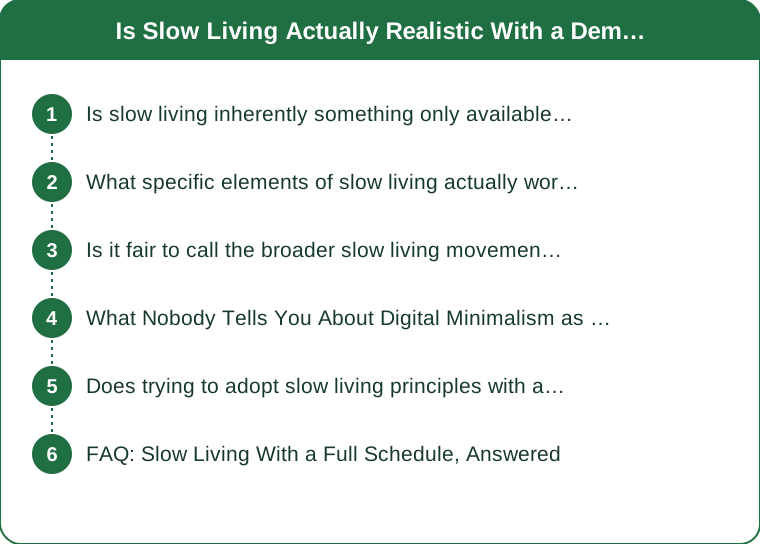
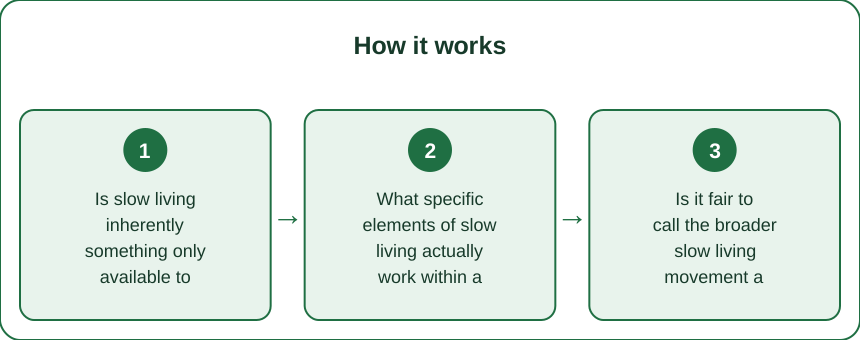
Is slow living inherently something only available to people with flexible schedules?
A lot of the imagery around it, yes — the aesthetic of unhurried mornings and open afternoons does assume a level of schedule flexibility that a demanding job doesn’t allow, which is a fair critique of how it’s often presented. That said, the underlying principles (presence, reduced multitasking, intentional pacing) don’t strictly require that flexibility to apply in smaller ways.
What specific elements of slow living actually work within a full-time job schedule?
Single-tasking during set periods — like eating lunch without a screen, or a commute without constant multitasking — applies the core principle without needing large blocks of open time. Protecting even 10-15 minutes of genuinely unhurried time daily, rather than trying to slow an entire day down, is a more realistic entry point than the full lifestyle version.
Is it fair to call the broader slow living movement a privilege issue?
There’s a legitimate critique here — the more visible, aspirational versions of slow living (leaving demanding careers, extensive time for hobbies) do require financial flexibility most people don’t have, and presenting that version as universally achievable advice overlooks real constraints. The more modest, schedule-compatible version is less discussed but more broadly accessible.

What Nobody Tells You About Digital Minimalism as an Entry Point
Reducing phone and notification clutter is often the most schedule-compatible slow living element, since it doesn’t require freeing up new time — it just changes how existing time (breaks, commutes, evenings) is spent. Many people report this specific change having a disproportionately large effect on the felt pace of daily life compared to its actual time cost.
Does trying to adopt slow living principles with a demanding job risk adding more pressure instead of less?
Yes, if approached as another thing to optimize or feel behind on — treating slow living as a checklist to complete perfectly defeats its own purpose. Choosing one or two small, sustainable changes rather than attempting a full lifestyle overhaul avoids this trap.
FAQ: Slow Living With a Full Schedule, Answered
Is single-tasking during a commute actually achievable for most people?
For commutes involving driving, this is often already the case out of necessity — for transit commutes, it requires a deliberate choice to skip constant phone use, which is achievable but does take intention.
Does a busy job mean slow living principles have no real benefit?
No — even small, consistent applications (protected minutes, reduced multitasking) show up in reported stress and presence levels, even without a full lifestyle change.
What’s a reasonable first step for someone skeptical that slow living applies to their schedule?
Picking one specific daily moment (a meal, a walk, the first 10 minutes home) to do without multitasking is a low-commitment way to test whether the principle offers real value before considering anything bigger.
TL;DR:
- The full aspirational version of slow living isn’t realistic for most demanding jobs
- Specific elements like single-tasking and protected minutes do transfer well
- The privilege critique of the aspirational version has real merit
- Reducing digital clutter is often the most schedule-compatible entry point
- Treating slow living as a checklist to perfect defeats its own purpose
The realistic version is smaller and less photogenic than the aesthetic — and still worth doing.
Keep Reading
This article is for general informational and styling purposes only. Fit, sizing, and product availability may vary.