How Do You Practise Slow Living in the Busiest Season of the Year?
Quick Answer: Slow living fails in autumn because most people practise it as added activities — the long walk, the unhurried morning — and those are the first things a full calendar removes. The version that survives is subtractive: fewer commitments, fewer decisions, and lower standards on things that do not matter, rather than more restorative activities layered on top of an unchanged schedule.
You had it working in July. Slow mornings, unhurried weekends, actually noticing things.
Then September arrived and by mid-October you have a full calendar, it is dark at five, and slow living has become one more item you are not doing.
The problem is usually not discipline. It is that most people learned a version of slow living that only works when you already have time.

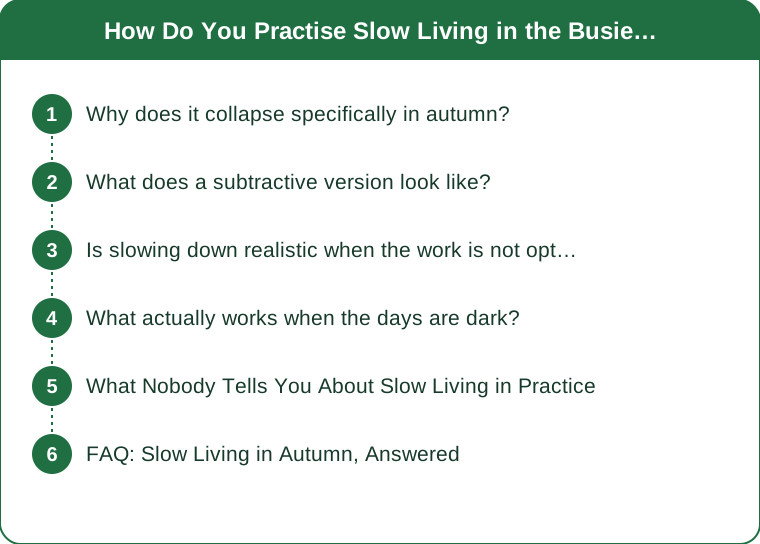
Why does it collapse specifically in autumn?
Three things converge, and they arrive within about six weeks of each other.
The calendar refills. School terms, work cycles, social seasons — autumn is structurally the densest part of the year for most people, and commitments made in September land in October and November.
Daylight shrinks fast. Between September and late October most northern latitudes lose several hours of usable daylight, and evening becomes something you get through rather than something you use.
And energy genuinely drops. Reduced light exposure affects mood, sleep timing and motivation for a large share of people. So you have more to do, less time in which it feels doable, and less energy for it.
Against that, a practice built on adding restorative activities has no chance. Adding a slow morning to a schedule that already does not fit is not a plan, it is a wish.
What does a subtractive version look like?
It targets what you remove rather than what you add.
Decide what does not get done this season. Not what gets postponed — what gets dropped. Autumn is a good time to name two or three standing commitments that are not going to happen, and to tell whoever needs telling.
Reduce decisions, not just tasks. Decision volume is a large and invisible source of fatigue. A repeating weekly meal plan, a smaller wardrobe, a fixed weekday routine — these feel restrictive in the abstract and feel like relief in November.
Lower standards deliberately on specific things. Not everything, and not vaguely. Pick three: the house is tidier at weekends only, dinner is simple on weeknights, replies are slower. Choosing where to be mediocre is a skill, and it is most of what makes a busy season survivable.
Protect one thing rather than restructuring everything. One unhurried evening a week, defended properly, is worth more than a whole philosophy applied inconsistently.
Is slowing down realistic when the work is not optional?
Sometimes not, and pretending otherwise is why people give up on it.
If you have caring responsibilities, a demanding job, or a season that genuinely requires more of you, the honest answer is that some periods are not slow, and the practice is about how you move through them rather than whether you can avoid them.
That version looks like: not adding anything voluntary, protecting sleep as the non-negotiable, being unhurried inside individual moments even when the day is not, and naming the end point — this is until mid-December, not forever.
The reframe that helps most: slow living is not a permanent speed. It is a relationship with your own pace, which includes recognising when you are in a fast season and not layering guilt on top of it.
Guilt about not being slow enough is the most self-defeating part of the whole idea, and it is worth dropping first.

What actually works when the days are dark?
Four things, all small.
Morning light, early. Fifteen minutes outside within an hour of waking does more for autumn energy than any evening routine. It is the highest-return habit of the season and it takes almost no time.
Move one restorative thing to the morning. Evening routines fail in autumn because evening energy is lowest. Whatever you were doing at 8pm in July will work better at 7am in November.
Make the evenings deliberately smaller. Lower lighting, fewer plans, earlier meals. Fighting the dark tends to lose; working with it — treating 6pm as evening rather than late afternoon — is more sustainable.
Batch and repeat instead of choosing. The same three dinners, the same weekly rhythm, the same route. Repetition looks like the opposite of intentional living and is actually what creates room for it.
One caution: if low energy and low mood persist for weeks, are affecting your functioning, or come with changes in sleep and appetite, that is worth speaking to a doctor about rather than treating as a lifestyle problem. This is general information, not medical advice.
What Nobody Tells You About Slow Living in Practice
It is mostly about saying no, and saying no is unpleasant. The aesthetic version is candles and a slow morning. The functional version is declining an invitation and sitting with the fact that someone is mildly disappointed. That is the actual skill.
It is easier with more money, and it is worth being honest about that. Many slow living recommendations assume control over your schedule, which is a resource not everyone has. The subtractive version travels better across circumstances than the version that requires free time.
Consistency beats intensity, and nobody wants to hear it. A twenty-minute routine you keep in November is worth more than a whole slow weekend you take in January.
The season ends. Late autumn is genuinely the hardest stretch, and the calendar loosens afterward. Treating it as a period to get through rather than a permanent failure of your system is more accurate and considerably kinder.
And you will drop it repeatedly. Everyone does. Restarting without a full audit of why you stopped is the whole practice, honestly.
FAQ: Slow Living in Autumn, Answered
Where do I start if my calendar is already full?
Look for the recurring commitments rather than the one-off events. A weekly thing you have stopped valuing costs far more over a season than any single evening. Cancel one recurring item this week — that is a bigger change than any morning routine you could add.
How do I do this with children at home?
Reduce the number of transitions rather than the number of activities. With children, most of the exhaustion is in the switching — getting out of the house, changing venue, changing mode. One long unhurried thing beats three short ones, even when the three sound gentler.
Is it worth doing at all in a season this busy?
Yes, but as subtraction rather than addition. The version that adds practices to a full schedule will fail and will make you feel worse. The version that removes commitments, reduces decisions and lowers standards in chosen places works in exactly the season where it is hardest — which is the only real test of it.
TL;DR:
- Autumn collapses slow living because the calendar fills, the light goes, and energy drops — all within about six weeks.
- Practise it subtractively. Remove commitments, reduce decisions, and deliberately lower standards on three named things.
- Move restorative habits to the morning and get 15 minutes of outdoor light early — evening routines fail when evening energy is lowest.
- Protect one thing properly rather than restructuring everything, and name the end point so it feels like a season rather than a life.
Drop the guilt first. Some seasons are fast, and treating that as a personal failure is the part that actually makes it worse.
Keep Reading
This article is for general informational and styling purposes only. Fit, sizing, and product availability may vary.