How Do You Explain Slow Living to People Who Think You Are Being Lazy?
Quick Answer: Do not explain slow living as a philosophy — explain it as a set of decisions with reasons. “I’m not taking that on because I’d do it badly” lands where “I’m practising slow living” does not. The label invites debate about the label; the decision invites nothing. And in most cases you owe far less explanation than you think you do. Describe the trade-off, not the ideology.
The accusation of laziness is almost never about you.
But the conversation still has to happen, so here is how to have it well.

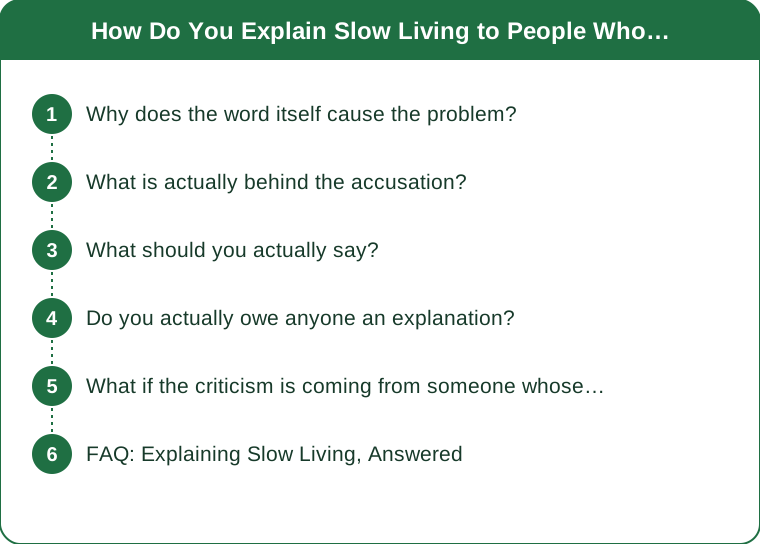
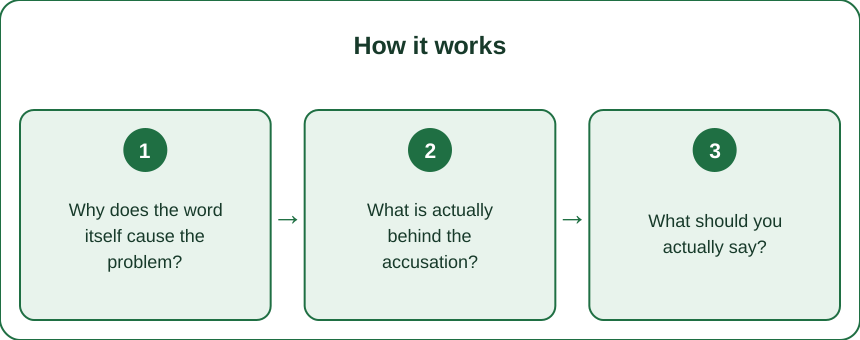
Why does the word itself cause the problem?
Because it arrives as a category, and categories invite people to argue with the category rather than with your actual choice.
Say “I’m practising slow living” and you have handed the other person a thing to have opinions about. They have probably seen it associated with a particular aesthetic, a particular income level, or a particular kind of person, and they are now responding to that rather than to you.
Say “I’ve stopped taking calls after six” and there is very little to argue with. It is specific, it is yours, and it does not represent a movement.
This is a general principle worth holding onto: the more ideological your framing, the more resistance you generate, because ideology invites counter-ideology. A decision framed as a personal trade-off is nearly unassailable, because the other person has no standing on your trade-offs.
There is a second problem with the label. “Slow” is a poor description of what most people are actually doing, which is usually fewer things, done properly. That is not slow. It frequently involves working intensely on a smaller number of things. But the word says slow, so people hear slow, and slow sounds adjacent to lazy.
Which is why most of the useful answers below never use the word at all.
What is actually behind the accusation?
Usually one of three things, and they need completely different responses.
Genuine concern. A parent worried you are limiting your prospects, or a partner worried about money. This is care in an unhelpful costume, and it responds to reassurance about the practical facts rather than to a defence of the philosophy.
Their own discomfort. Your visible choice to do less makes their choice to do more look like a choice rather than a necessity. That is uncomfortable, and discomfort frequently comes out as criticism. Very little you say will resolve this, and trying usually makes it worse.
A real professional issue. Sometimes the concern is legitimate — a manager noticing you are less available, a friend noticing you have declined the last four invitations. This one deserves a genuine answer rather than a boundary.
The first move in any of these conversations is to work out which one you are in, because the responses are not interchangeable. Reassuring someone whose real issue is their own discomfort does not help. Defending a boundary to someone with a legitimate work concern makes you look exactly as advertised.
A reasonable diagnostic question: “Is there something specific that’s not working?” If they can name something, it is category three. If they cannot, it is one of the other two.
What should you actually say?
Short answers, in the moment, without a preamble. Here are ones that work.
To a colleague or manager:
“I’m covering fewer things so the ones I have get done properly.” — Frames it as quality, which is a professional value nobody argues with.
“I’d rather do three things well than six adequately.” — Invites agreement rather than debate.
“I’m at capacity. If this is a priority, what should come off?” — The strongest one available, because it moves the decision to them.
To family:
“I’ve been happier since I stopped trying to fit everything in.” — Personal, factual, not arguable.
“I’m fine financially, if that’s the worry.” — Addresses the actual concern directly and usually ends the conversation.
To friends:
“I’m saying yes to less, so when I say yes I mean it.” — Reframes declining as commitment rather than withdrawal.
“Can we do something in the daytime instead?” — Offers an alternative, which is what most friends actually want.
Notice what none of these do: none of them explain a philosophy, apologise, or ask for approval. The most effective version of this conversation is consistently the shortest one.

Do you actually owe anyone an explanation?
Far less often than the anxiety suggests, and the distinction is worth being clear about.
You owe an explanation where someone’s work depends on yours, where you have changed an arrangement they were relying on, or where you are declining something you previously committed to. These are real obligations and dodging them is what genuinely earns the reputation you are worried about.
You do not owe an explanation for how you spend your own time, for declining optional social plans, for not taking on additional work, or for not pursuing a promotion. These are yours.
The practical difficulty is that the second category feels like it demands justification, because declining without a reason feels rude. It is not — it feels rude because most of us are unpractised at it.
A useful middle ground is what might be called the complete sentence: a decline with a reason that does not open a negotiation.
“I can’t make Thursday.” is complete. It does not invite a follow-up.
“I can’t make Thursday because I’ve been trying not to have too many evenings out.” is an invitation to solve your problem for you, and someone will.
The rule of thumb: give reasons where they are owed, and stop giving them where they are not. Most of the exhausting conversations come from explaining in the second category, which turns a decision into a debate you did not need to have.
This is particularly relevant right now, as autumn brings the seasonal wave of new commitments — clubs, terms, projects, calendars filling for the last quarter of the year. The pressure to justify not joining things peaks in September and October.
What if the criticism is coming from someone whose opinion matters?
Then it is worth a longer conversation, and there is a structure that works.
Step one: acknowledge the concern as legitimate. Not the accusation — the concern underneath it. “I know it looks like I’m pulling back, and I get why that’s worrying.” This costs you nothing and it changes the temperature of the conversation completely.
Step two: give one concrete fact. Numbers, outcomes or specifics beat philosophy. “I’ve delivered everything on time this quarter” or “we’re saving the same amount as last year” does more than any amount of describing your values.
Step three: name the trade-off out loud. People trust a choice more when they can see you understand its cost. “I’m probably slower to progress than if I said yes to everything, and I’ve decided that’s a fair price.” Someone who can articulate the downside sounds like they made a decision. Someone who only lists benefits sounds like they are avoiding something.
Step four: ask what would reassure them. Frequently the answer is small and specific — a partner wants to know you have thought about the money, a manager wants to know you will flag it early if something slips. These are easy to give and they end the recurring conversation.
Step five: do not relitigate it. Once is a conversation. Every fortnight is a campaign, and it will not persuade anyone.
And if it comes from someone whose opinion genuinely should not carry weight, the correct number of times to have this conversation is zero. “That’s fair enough” ends it perfectly well, and it commits you to nothing at all.
FAQ: Explaining Slow Living, Answered
What if someone calls it privilege rather than laziness?
Sometimes an honest point. Time flexibility is unevenly distributed and pretending otherwise is not a good look. The reasonable response is to agree that circumstances differ and to be specific about what you actually do rather than prescribing it to anyone — most of the friction comes from advocacy, not from practice.
How do I handle this at work without damaging my career?
By talking exclusively in terms of output and priorities rather than lifestyle. “Here’s what I can deliver well, here’s what would have to move” is a professional conversation. It is also, incidentally, how well-run teams operate anyway.
What if my partner thinks I am doing less than my share?
That is a different conversation and it deserves to be — it is about fairness at home, not about pace of life. Compare the actual distribution of tasks honestly. If it turns out to be uneven, the criticism is valid and the label is beside the point.
Should I stop using the term entirely?
With people who are curious, use it. With people who are skeptical, describe the decisions instead. It is not dishonesty, it is picking the framing that communicates rather than the one that triggers a debate.
What if I am actually just tired rather than living deliberately?
Worth asking yourself honestly and periodically. There is a real difference between choosing to do less and being unable to do more, and persistent exhaustion, low mood or loss of interest are worth raising with a GP rather than reframing as a philosophy.
How long before people stop commenting?
Usually a few months of consistency. The comments are mostly a response to change rather than to the state itself, and they fade once your pattern stops being new information.
TL;DR:
- Explain decisions and trade-offs, not a philosophy — the label invites debate about the label
- Work out first whether you are facing genuine concern, someone else’s discomfort, or a real professional issue
- You owe explanations where others depend on you, and rarely anywhere else
- Use complete sentences that close rather than reasons that invite negotiation
- Naming the cost of your choice out loud makes it sound like a decision rather than an avoidance
Pick one sentence from this page and have it ready before the next time it comes up. Having the answer in advance is what turns a defensive conversation into a two-second one.
Keep Reading
This article is for general informational and styling purposes only. Fit, sizing, and product availability may vary.