Slow Living With a Full-Time Job: Your Questions, Answered
Quick Answer: Slow living with a full-time job is not about having fewer commitments - it is about reducing the number of transitions and decisions inside the commitments you already have. The practical version is: fewer contexts per day, more single-tasking, protected buffers between things, and deliberately doing two or three ordinary tasks slowly rather than trying to slow your whole life. It is a texture change, not a schedule change.
Every slow living guide seems to be written by someone with a Tuesday morning free.
Yours is not free, and the idea still applies - just not in the way the photographs suggest.

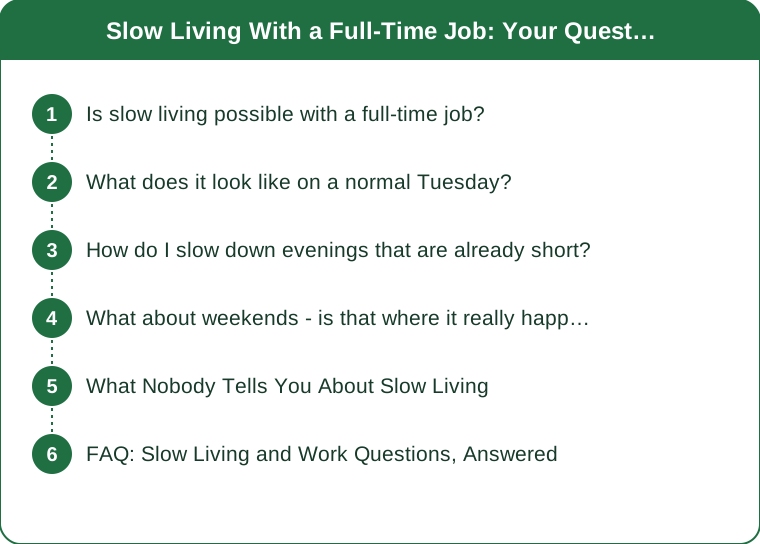
Is slow living possible with a full-time job?
Yes, but not as usually presented. Most of the visible version is really an aesthetic about having time, which is a resource question rather than a philosophy.
The underlying idea is about attention, not hours - doing one thing at a time, with awareness, rather than three things partially.
Which is available in a busy week, because it changes how tasks are done rather than how many there are.
The practical unit is the transition, not the hour. Most of the frantic feeling in a full day comes from switching contexts, not from the work itself.
Reducing switches is achievable at any level of busyness, and it is what people actually feel when they say a day felt calm.
Start there rather than trying to find free hours that may genuinely not exist.
What does it look like on a normal Tuesday?
One task at a time, with the other tabs closed. This is the whole practice compressed into a sentence, and it is harder than it sounds.
Batch similar work so that you change context four times a day instead of twenty.
Protect a ten minute buffer between meetings rather than stacking them back to back, which is the highest-value calendar change available to most people.
Choose two or three ordinary tasks to do slowly on purpose - making coffee, walking to the station, washing up - and actually do them at a normal human pace.
Eat lunch away from your screen at least twice a week, which is a modest and noticeable change.
And leave the phone in another room for the first twenty minutes at home, which is the most commonly reported single improvement in this whole area.
How do I slow down evenings that are already short?
Reduce the number of things you attempt, rather than trying to do the same number more calmly. Three things done well beats six done partially.
Decide the evening before it starts. Unplanned evenings tend to fragment into small tasks and phone time, and then feel like they disappeared.
Front-load anything that has to happen so the last hour is genuinely free rather than shadowed by an outstanding task.
Have one recurring slow evening a week rather than aiming for all of them, which is achievable and therefore sustainable.
Lower the light after 8pm, which changes the feel of a room more than almost any other single action and helps sleep as a bonus.
And accept that some weeks will not have this at all. A practice that requires every week to cooperate is not a practice, it is a mood.

What about weekends - is that where it really happens?
Partly, but weekends are where the concept most often collapses, because they get loaded with everything the week could not hold.
Leave one half-day genuinely unscheduled, which is more valuable than any specific slow activity.
Do the admin in one block rather than spread across both days, because scattered admin makes the whole weekend feel like it had work in it.
Resist the urge to optimise the weekend, which is the most common way slow living becomes another performance.
One long walk, one unhurried meal, one thing done with your hands is a reasonable weekly template and requires no lifestyle change.
And notice that early autumn is a natural moment for this, as the light shifts and outdoor time becomes something you do deliberately rather than by default.
What Nobody Tells You About Slow Living
It can become another optimisation project, complete with tracking, purchases and a sense of falling behind. If your slow living has a to-do list and a shopping cart, something has gone sideways.
The aesthetic and the practice are largely unrelated. Linen, ceramics and a tidy kitchen photograph beautifully and have almost nothing to do with attention. You can live slowly in a cluttered flat and frantically in a beautiful one.
Slowness is not the same as rest. Doing something demanding at an unhurried pace with full attention is very much in the spirit; scrolling on the sofa for two hours is rest but not slowness.
Most of the frantic feeling comes from switching, not from volume. People with genuinely packed days often feel calmer than people with light days full of fragmented attention, and this surprises everyone who hears it.
It is easier when your environment is not fighting you. Notifications off, phone out of reach, one browser window - the environment does more work than willpower does.
Some seasons of life do not allow it, and saying so honestly is better than the guilt of failing at a practice that requires resources you do not currently have. New parents, carers and people in crisis periods are not doing it wrong.
And the practice is renewable. You do not lose progress by having a chaotic month. You just start again on a Tuesday, with one task and the other tabs closed.
FAQ: Slow Living and Work Questions, Answered
Do I have to quit my job or move to the countryside?
No, and the framing that you might is what makes the whole idea feel inaccessible. The practice is about attention and transitions, both of which are available in a city flat with a full calendar.
How is this different from mindfulness?
They overlap substantially. Mindfulness is usually framed as a practice you do; slow living is usually framed as how you arrange ordinary activity. In daily terms the difference is mostly vocabulary.
What is the single highest-value change?
For most people, protecting buffers between commitments and single-tasking during work. Both reduce transitions, which is where the frantic feeling comes from.
Does it require getting up earlier?
Not at all, and doing so at the cost of sleep is usually counterproductive. An unhurried twenty minutes at any point in the day beats a resented 5am.
How do I do this with children around?
Expect it to look different - shorter, more interrupted, and located in ordinary tasks rather than in protected quiet. Doing one thing at a time with a child present is still doing one thing at a time.
How long before it feels different?
Usually within a week or two, because you are changing the texture of days rather than waiting for an outcome. If it feels like a project you are grinding through, you have made it into work again.
Is it worth reading more about it?
A little. It is a simple idea with a large content industry attached, and reading more about it is one of the more reliable ways to spend an evening not doing it.
TL;DR:
- Slow living with a full-time job is about reducing transitions, not commitments.
- Batch similar work, close the other tabs, and protect buffers between meetings.
- Pick two or three ordinary daily tasks and do them at a normal human pace.
- Decide the evening before it starts, and aim for one slow evening a week rather than all of them.
- Leave one weekend half-day genuinely unscheduled.
- The aesthetic and the practice are almost unrelated - it works fine in a cluttered flat.
It is a change in texture, not in schedule, which is why a full week does not disqualify you.
Keep Reading
This article is for general informational and styling purposes only. Fit, sizing, and product availability may vary.