Is Slow Living Harder in Autumn? Your Questions, Answered
Quick Answer: Autumn is harder than it looks because the calendar accelerates - school terms, work quarters, and holiday planning all restart - at the same time as daylight contracts. Slow living in autumn is less about adding rituals and more about protecting the two or three hours that the season is actively trying to take from you.
Autumn is the season slow living is sold in. Blankets, candles, a book, rain on a window.
And then October arrives and you are busier than you were in July, it is dark at five, and the version of the season in the photographs is nowhere in evidence.
That gap is not a personal failure. Several things happen at once in autumn, and most of them work against a slow life.

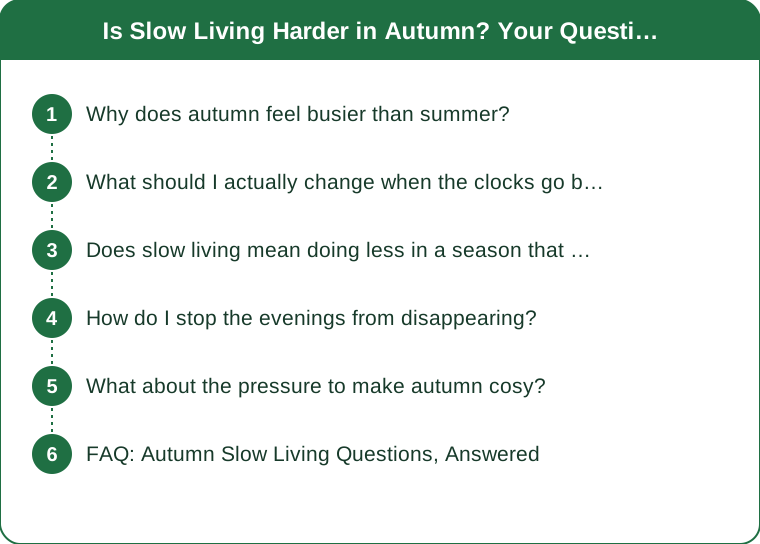
Why does autumn feel busier than summer?
Because almost every institutional calendar restarts in September, and they restart together.
School terms begin. Work returns from the summer lull and quarterly deadlines appear. Social calendars refill after August. Anything that was deferred with the phrase after the summer arrives all at once, and it arrives in a six-week window.
Meanwhile daylight is contracting by two or three minutes a day. By late October most people have lost several hours of evening light compared with June, and the hours that go are exactly the ones that were unstructured - the after-work walk, the light dinner outside, the sitting about.
So the demands rise and the discretionary hours fall in the same period. That is a squeeze from both ends, and it is the actual reason autumn feels hard, rather than anything about temperament or discipline.
Understanding that changes what the response should be. Adding a new morning routine to a season that is already compressing you is the wrong move. Defending what you already have is the right one.
What should I actually change when the clocks go back?
One thing, well, rather than five things badly.
The clock change removes an hour of evening light in a single night, and the standard response is to try to carry on as before and feel steadily worse about it. The alternative is to decide in advance what that hour becomes.
The most useful reframe is that you are not losing an hour, you are relocating it. The light moved to the morning. If you can move anything you currently do in the evening light to the morning light - a walk, a coffee outside, exercise - you keep it. If you cannot, then the evening hour needs to become something that works in the dark rather than a worse version of something that needed light.
A specific, small suggestion: pick the hour immediately after the clock change and give it a fixed identity. Reading, cooking properly, a phone call with someone you like. Not a schedule for the whole winter - just the one hour, decided once, so it stops being a nightly negotiation you lose.
The negotiating is what makes it exhausting. A decided hour costs nothing to maintain.
Does slow living mean doing less in a season that demands more?
No, and this is where the concept gets misread most often.
Slow living has never been about volume. It is about the relationship between what you do and whether you chose it. A full autumn of things you actually want to be doing is entirely compatible with it; a half-empty autumn of obligations you drifted into is not.
Autumn is a useful test of that precisely because so much lands in a short window. Almost everything that arrives in September arrives as a default rather than a choice - the standing commitment that restarts, the group that meets again, the annual thing that happens because it happened last year.
The autumn version of the practice is a review rather than a routine. Look at what restarted in the last month and ask which of them you would start today if it were not already running. Some will survive that question easily. One or two will not, and those one or two are where the hours come from.
This is more useful in September than in January, because in September the things are just restarting and are easy to not restart. By January they are established again and stopping them requires an announcement.

How do I stop the evenings from disappearing?
By noticing that the evening does not disappear gradually. It disappears at a specific moment, and for most people that moment is the transition between the working day and the rest of it.
In summer, that transition is handled by light and by being outside. In autumn there is no external marker at all - it is dark before you finish, so nothing tells your body that the day changed. Without a marker, work bleeds forward and the evening never quite begins.
The fix is to build the marker yourself, and it needs to be physical rather than mental. Changing clothes works. Going outside for five minutes in the dark works surprisingly well. Cooking works if you actually cook rather than assemble. What does not work is deciding that the evening has started while sitting in the same chair looking at the same screen.
The second thing that eats evenings is lighting. A room lit from the ceiling at six in the evening reads as an extension of the working day. The same room lit by two lamps at eye level reads as somewhere you are not working. This is a genuinely large effect for something that costs the price of a lamp.
Third: get the light in the morning. Ten minutes of daylight before nine does more for how the evening feels than anything you do in the evening itself, because it anchors the whole body clock earlier. In autumn this often means going outside before you feel ready to, which is the least appealing and most effective item on this list.
What about the pressure to make autumn cosy?
It is worth naming, because it is genuinely part of why the season is hard.
Autumn arrives with more aesthetic expectation attached to it than any other season. There is a correct-looking version of it circulating constantly, and it is one where nobody is commuting in the dark or dealing with a wet coat in a hallway.
A useful correction: everything in that version is a product of having time, and time is exactly what the season removes. The imagery is not describing a mood you should be able to summon. It is describing an afternoon somebody had free.
What you can reasonably keep from it is one small thing done properly. A candle actually lit rather than owned. A blanket where you sit rather than folded. Ten minutes of the thing rather than an evening of it.
The test for whether a slow living practice is working is not whether it looks like the pictures. It is whether the hour you spent on it felt like yours. That is available in a small flat on a wet Tuesday, and it is not available in a beautifully arranged room you are photographing.
Is it normal to feel worse in autumn?
A dip in mood and energy as light reduces is very common and largely a light-exposure effect. Morning daylight, keeping a consistent wake time, and staying physically active all help. A dip that is severe, that persists, or that interferes with daily functioning is worth raising with a doctor, since seasonal affective disorder is treatable. This is general information, not medical advice.
Should I set slow living goals for the season?
Generally no. Goals import the exact framework the practice is trying to step out of. A single decided hour and one thing you stopped doing will outperform a list every time.
FAQ: Autumn Slow Living Questions, Answered
Is it better to wake earlier or later in autumn?
Consistent beats either. A stable wake time year-round is the single strongest anchor for both sleep and mood. If you shift at all, shift slightly earlier to catch the morning light rather than later to avoid the dark.
How do I do this with young children in the house?
By accepting that the hour will not be a whole hour and not treating that as failure. Fifteen minutes that belong to you, at a predictable point in the day, is the real version of this for most people with small children.
Does slow living conflict with holiday preparation?
Only if the preparation is unchosen. Starting earlier and doing less is the slow-living version of December, and it is decided in October - which is another reason the autumn review matters more than it looks.
TL;DR:
- Autumn compresses you from both ends: institutional calendars all restart while discretionary daylight hours disappear.
- Defend existing time rather than adding new rituals - September is the wrong month to build a routine.
- Build a physical marker between work and evening, light rooms at eye level, and get daylight before nine.
- Review what restarted in the last month and ask what you would not start today.
The season in the photographs is not a mood you failed to summon. It is an afternoon somebody had free - and the honest autumn version of slow living is protecting one decided hour, not recreating the picture.
Keep Reading
This article is for general informational and styling purposes only. Fit, sizing, and product availability may vary.