Does Slow Living Fall Apart When You Have Kids at Home?
Quick Answer: No, but the version sold in photographs does. Slow living with children at home cannot mean an unhurried pace, because the pace is not yours to set. What it can mean is fewer commitments, fewer transitions per day, and protecting a small number of unhurried moments rather than an unhurried life. The people who make it work redefine the unit from the day to the moment.
You read about slow mornings and then remembered that your morning contains a lost shoe, a permission slip, and someone who will not put on a coat.
So is the whole idea just for people with a different life? Not quite — but the honest answer requires dropping a few things first.

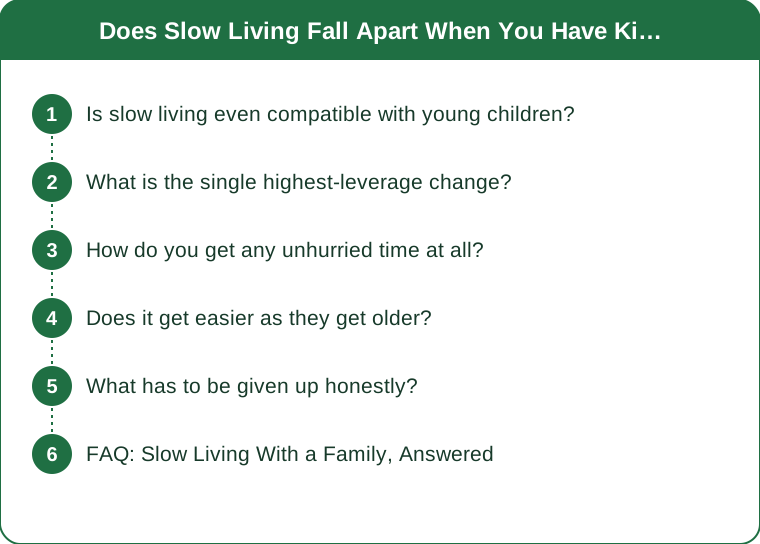
Is slow living even compatible with young children?
Yes, but only if you stop defining it as a pace.
The version that circulates online is built around control of time — long mornings, unhurried meals, spacious afternoons. Children remove exactly that control. Their needs are non-negotiable and badly timed, and no amount of intention changes when a four-year-old needs the toilet.
What remains available is control over commitments, not over pace. You cannot make the school run unhurried. You can decide whether there is an activity afterwards.
This reframe is the whole thing. Slow living for a parent is not about moving slowly through a full day — it is about a less full day that still contains fast parts.
A useful test: look at last week and count how many separate places the family had to be. That number is the one you actually control, and it is a far better measure of whether life feels frantic than how calmly you moved between them.
What is the single highest-leverage change?
Reducing the number of transitions per day.
Transitions — leaving the house, arriving somewhere, changing activity, getting into the car — are where friction concentrates. Almost all the difficult moments of a family day happen at a transition rather than during an activity.
An afternoon with one outing and a long stretch at home contains perhaps four transitions. An afternoon with two activities and a shop contains ten or twelve. The second afternoon is not twice as hard; it is several times as hard, because each transition carries its own negotiation.
Practical version: aim for one out-of-house commitment per day outside of school, and none at all on at least two days a week.
This sounds obvious and is remarkably hard to hold, because each individual thing is worthwhile and declining feels like deprivation. The discipline is in seeing the cumulative shape rather than each item on its own merits.
How do you get any unhurried time at all?
By shrinking the unit from the day to the moment, and defending a small number of them.
A whole slow morning is not available. Fifteen unhurried minutes is.
The candidates that tend to work:
- The first fifteen minutes before anyone else is up. Not to be productive — that turns it into work. Just to exist unaccompanied.
- One meal a week that is genuinely unrushed, usually a weekend breakfast, with nowhere to be afterwards.
- The walk somewhere, done deliberately slowly, when there is enough margin to allow it.
- The last twenty minutes of the evening, protected from admin.
The critical move is to protect one of these rather than aspire to all of them. People who try to slow the whole day tend to fail and conclude slow living is not for them. People who guard a single reliable pocket tend to keep it for years.
And the pocket has to be genuinely unproductive. A slow morning spent doing life admin is not the thing; it is just quieter work.

Does it get easier as they get older?
It changes rather than eases, and in ways worth anticipating.
Under five: the constraint is physical — you cannot leave the room. Slow living here means accepting that most of your time is not yours and finding the pocket at the edges, usually early morning or after bedtime.
Five to ten: the constraint shifts to logistics. Children can occupy themselves, but the calendar fills with activities, parties and clubs. This is the age at which families accidentally become frantic, because each commitment is small and the total is enormous. The work here is saying no.
Ten and up: the constraint is emotional availability. Older children need you at unpredictable times and often at length, usually late in the evening. Slow living here means having margin in the evening rather than filling it, so that you are available when the conversation happens.
Across all of it, the thing that does not get easier is the pull of other families’ calendars. The pressure to match what others are doing is strongest in the middle band and rarely goes away entirely.
What has to be given up honestly?
Three things, and pretending otherwise is why people bounce off the idea.
The aesthetic. A slow-living home with children in it does not look like the photographs. There will be plastic, and there will be mess, and the linen will be creased. If the appeal was the visual, this will disappear immediately and the disappointment is worth expecting.
Consistency. Some weeks will simply be fast. Illness, work deadlines and school events override everything. The measure has to be the season rather than the week, or every difficult fortnight reads as failure.
Some social participation. A calendar with genuine space in it means declining things other families accept. This has real costs — occasionally for the children, who notice. It is worth being honest that the trade is a trade, not a free improvement.
What you get in return is a household that is not permanently on the edge of its capacity, which shows up mostly as fewer bad evenings and shorter recoveries from disruption.
And one thing that does not have to be given up: ambition. Slow living is often read as low-effort living, which is a misreading. It is about reducing the number of things, not the intensity of the ones remaining. A demanding job and a slow household are compatible; a demanding job plus five weekly activities plus a full social calendar is not.
FAQ: Slow Living With a Family, Answered
How do I start when the calendar is already full?
Do not try to redesign it. Pick one recurring commitment and let it lapse at the natural end of a term or season, and do not replace it. One removal that sticks beats a reorganisation that collapses in three weeks.
Do the children need to be on board?
Less than you would think for the calendar changes, more than you would think for the household ones. Children generally adapt quickly to fewer activities once the initial protest passes, and often report liking it. Changes that affect their belongings or their rooms need their involvement, or they become something done to them.
Is it selfish to protect time for myself?
This question comes up constantly and is worth answering plainly: a parent operating at zero margin is less available, not more. The fifteen protected minutes are not taken from the family — they are what makes the rest of the day survivable. The framing of self-care as indulgence tends to produce households that run on empty and then break.
TL;DR:
- Slow living with children cannot mean a slow pace — the pace is not yours to set. It means fewer commitments.
- Reducing transitions per day is the highest-leverage change; aim for one out-of-house commitment and two empty days a week.
- Shrink the unit from the day to the moment, and defend one reliable pocket rather than aspiring to a slow whole day.
- The constraint changes with age: physical under five, logistical to ten, emotional availability after that.
- The honest trade-offs are the aesthetic, week-to-week consistency, and some social participation.
The version in the photographs was never available to anyone with a school run, and treating it as the target is why most parents conclude the whole idea is not for them. The version that survives is much less photogenic and much more durable: a shorter list, fewer places to be, and fifteen minutes that belong to nobody else.
Keep Reading
This article is for general informational and styling purposes only. Fit, sizing, and product availability may vary.