Does Slow Living Actually Mean Saying No to More Social Plans?
Quick Answer: Slow living doesn’t inherently mean saying no to more social plans — it means being more intentional about which plans you say yes to, so the calendar reflects things that genuinely matter rather than obligation-driven filler, which can actually mean saying yes to fewer low-value plans and more fully present time with people who matter.

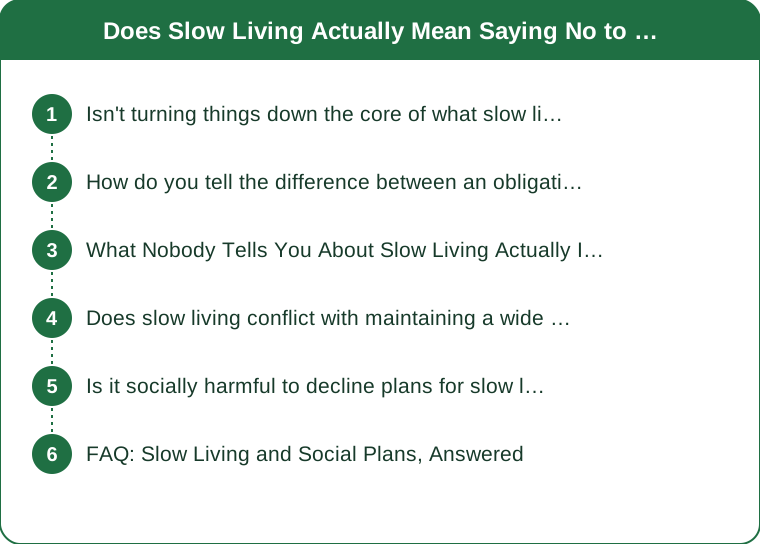
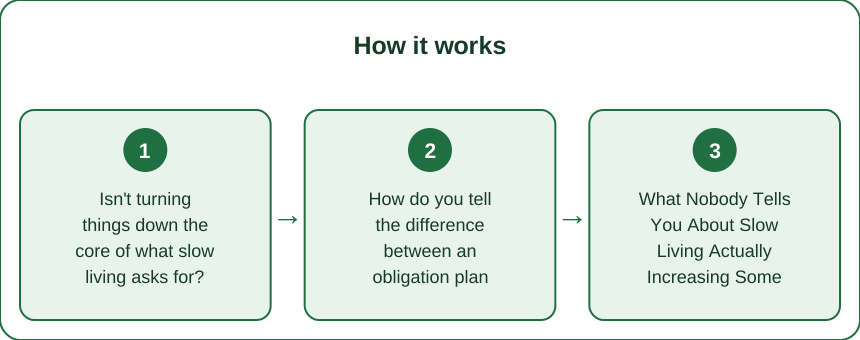
Isn’t turning things down the core of what slow living asks for?
Slow living is often misunderstood as pure subtraction, but the actual principle is intentionality, not minimization — the goal isn’t necessarily fewer plans on the calendar, it’s fewer plans made out of obligation or habit rather than genuine desire to be there.
How do you tell the difference between an obligation plan and a genuine one?
A useful gut-check is asking whether you’d still want to go if there were zero social consequence to declining — if the honest answer is no, that plan is likely obligation-driven, and slow living principles would suggest it’s a reasonable one to skip in favor of something more genuinely wanted.
What Nobody Tells You About Slow Living Actually Increasing Some Social Time
For some people, practicing slow living principles means more quality one-on-one social time, not less, because clearing out obligation-driven group plans and rushed interactions frees up calendar space and energy for longer, unhurried time with a smaller number of people — a net increase in a specific kind of connection.

Does slow living conflict with maintaining a wide social network?
Not inherently, though it does often naturally shift energy toward fewer, deeper relationships over a very wide but shallow network — this isn’t a strict requirement of the philosophy, but a common natural effect of prioritizing quality and presence over volume of social contact.
Is it socially harmful to decline plans for slow living reasons?
Framing a decline around genuine capacity and presence, rather than a vague dismissal of the person’s plan, generally lands better than an unexplained no — being honest that you want to show up fully rather than half-present tends to be received as thoughtful rather than dismissive.
FAQ: Slow Living and Social Plans, Answered
Can someone practice slow living while still having a busy social calendar?
Yes — the busyness itself isn’t the disqualifier; what matters is whether the plans on that calendar are chosen intentionally rather than out of default obligation.
Does slow living recommend a specific number of social plans per week?
No — there’s no universal number; the practice is more about the quality of attention brought to each plan than hitting or staying under a specific count.
How do you slow living-proof a plan you already feel obligated to attend?
Bringing full presence and phone-free attention to a plan you can’t reasonably decline is itself a slow living practice, even if the plan’s existence wasn’t fully optional.
TL;DR:
- Slow living is about intentionality in social plans, not automatic subtraction
- The gut-check: would you go if there were zero consequence to declining?
- It often shifts energy toward fewer, deeper connections rather than eliminating socializing
- Declining with honesty about wanting to show up fully tends to land better than a vague no
It’s less about a quieter calendar and more about a calendar that actually reflects what you’d choose without outside pressure.
Keep Reading
This article is for general informational and styling purposes only. Fit, sizing, and product availability may vary.