Does Slow Living Survive the September Schedule Reset?
Quick Answer: Most slow-living practices fail in September not because people stop valuing them but because they were built for a low-demand month and never tested against a full calendar. The ones that survive share a specific property — they take under five minutes, attach to something that already happens daily, and don’t require the day to cooperate. Rebuild around that property before the calendar fills, not after.
August let you have slow mornings. September is about to take them, and it takes them the same way every year.

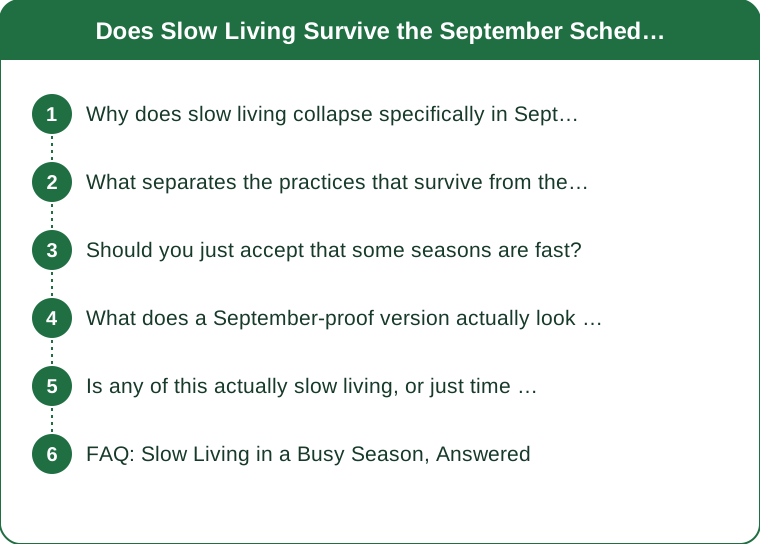
Why does slow living collapse specifically in September?
Because the practices were built during a month with structural slack, and slack is the thing September removes first.
Summer creates a false test environment. Fewer meetings, later sunrises, people out of office, a general permission to move at 80%. A twenty-minute morning practice is easy to sustain when nothing is competing for that twenty minutes.
September restores every competing demand at once — school schedules, quarterly planning, the return of everyone who was away, the general institutional urge to make up for August. It’s not a gradual ramp. Most people’s calendar density roughly doubles inside two weeks.
A practice that requires slack disappears the moment slack does. This is the whole failure. Not a motivation problem, not a discipline problem — a design problem. The practice was never load-bearing.
The pattern this produces
Week one of September: the practice survives, barely. Week two: it’s skipped twice. Week three: it’s gone, and it’s replaced by a low-grade guilt that makes restarting less appealing. By October people conclude slow living “doesn’t work for their life,” when what didn’t work was a July-shaped habit in a September-shaped month.
What separates the practices that survive from the ones that don’t?
Three properties, and a practice needs all three to make it through a dense month.
It takes under five minutes. Not “can be shortened to five minutes” — is genuinely designed at five. Anything longer is competing with the calendar directly, and the calendar wins in a busy season every time.
It’s anchored to something that already happens unconditionally. The first cup of coffee. Closing the laptop. Walking to the car. These happen whether or not the day goes well, which means the practice inherits their reliability. A practice anchored to “when I have time” is anchored to nothing.
It works badly without failing. A three-minute version done poorly still counts. Practices with a quality bar — meditate well, journal thoughtfully — get skipped on the days you most need them, because on a hard day you correctly predict you’ll do them badly.
The counterintuitive part
Shrinking the practice in September usually preserves more benefit than protecting its length does. A two-minute version every day beats a twenty-minute version twice. The value in these practices compounds through frequency, not duration, and September is a frequency test.
Should you just accept that some seasons are fast?
Partly — and the distinction between accepting the pace and abandoning the practice is the whole thing.
Yes, the pace is real. Refusing to acknowledge that September is denser than August produces a plan that fails and a story about personal failure attached to it. Some months are genuinely busy, and pretending otherwise is its own kind of denial.
No, that doesn’t mean pausing until things calm down. “I’ll restart when it settles” is the most common exit from slow living, and it’s a trap for a simple reason: the thing that settles in November gets replaced by the holidays, and January brings its own reset. There is no month that arrives pre-cleared.
The honest version is a reduced practice held continuously. Not because two minutes of it is transformative on its own, but because a practice that never fully stops takes almost no energy to expand again in a quieter month. A practice that stops takes as much energy to restart as it took to build.
What genuinely can be paused: anything aspirational you added in a good month. The new hobby, the extended routine, the ambitious version. Cut those deliberately and say so, rather than letting them erode and calling it a failure.

What does a September-proof version actually look like?
Concrete, and smaller than most people expect.
Morning: three minutes before the phone. Not a routine — a boundary. Coffee made, sitting down, phone in another room, for as long as the first few sips take. This survives because it’s attached to the coffee, which happens regardless.
Midday: one meal not at a screen. One. Not all of them. Fifteen minutes, and if the meal is at your desk with the laptop shut, that counts.
Transition: two minutes between work and home. Sitting in the car before going in, or one lap around the block. This is the single highest-return two minutes in a dense month, because it prevents the workday from bleeding into the evening — which is the actual thing that makes September feel relentless.
Evening: a hard stop on inputs 30 minutes before bed. Not a wind-down routine with steps. Just a time after which nothing new comes in.
Weekly: one unscheduled two-hour block, defended like a meeting. Put it on the calendar with a name. Blocks without names get taken.
What to drop without guilt
The hour-long morning routine. The elaborate weekend reset. The reading goal. These are good-month practices and they belong in good months. Naming them as seasonal rather than failed is most of the difference in how the fall feels.
Is any of this actually slow living, or just time management?
Fair question, and the difference is in what the practice is for.
Time management optimizes throughput. It asks how to fit more in, or how to fit the same in with less friction. The measure is output.
These practices optimize for presence at specific points. The three minutes before the phone doesn’t make the day more efficient — it arguably costs three minutes. Its purpose is that the day starts from a decision rather than from a notification.
The overlap is real and not worth policing. A defended two-hour block looks like calendar management and functions as protected attention. Both descriptions are accurate.
Where they genuinely diverge is what you do with recovered time. Time management refills it. Slow living leaves some of it empty on purpose — and September is precisely the month where that distinction gets tested, because a newly free hour in a busy month is under immediate pressure to become productive.
The test question: when the two-hour block arrives, do you fill it with the thing you’ve been meaning to get to? If yes, that’s time management wearing a slow-living label, and it will feel like one more obligation by week three.
FAQ: Slow Living in a Busy Season, Answered
How far in advance should I shrink my practices?
Before the calendar fills, not after. Late August is the window — once September density arrives, redesigning takes energy you won’t have.
What if I’ve already lost the routine this year?
Restart at the smallest possible version, not the previous one. Two minutes tomorrow beats a plan to resume the full routine on Monday.
Does slow living require doing less overall?
No. It requires choosing deliberately rather than by default. Some deliberate lives are quite full.
How do I defend a block when everyone wants that time?
Name it on the calendar and treat it as immovable for four weeks. Blocks survive on precedent, and the precedent takes about a month to set.
Is it worth doing a two-minute practice at all?
Yes, and mostly for a structural reason — an unbroken practice expands easily, while a stopped one has to be rebuilt from zero.
TL;DR:
- Slow-living practices usually fail in September because they were designed in a month with structural slack
- Survivable practices take under five minutes, anchor to something unconditional, and tolerate being done badly
- Shrink the practice before the calendar fills — frequency compounds, duration doesn’t
- The two minutes between work and home is the highest-return block in a dense month
- Name the aspirational practices as seasonal rather than letting them erode into guilt
September takes the slack, not the values. Build the version that doesn’t need slack and the rest of the fall gets considerably easier.
Keep Reading
This article is for general informational and styling purposes only. Fit, sizing, and product availability may vary.