Does Slow Living Work When You Have Young Kids?
Quick Answer: Yes, but almost nothing about the usual version transfers. With young children you cannot control the pace of your day, so slow living has to move from scheduling to sequencing — doing one thing at a time rather than doing fewer things. The three practices that survive contact with a four-year-old are single-tasking, building in transition buffers, and cutting recurring commitments rather than daily tasks. The aesthetic version — long mornings, quiet houses, unhurried afternoons — does not survive, and pretending otherwise is why most parents give up on the idea.
Every slow living photograph contains the same thing: an empty room. No one is asking for a snack in it.
So the honest question is not whether you can have those mornings. You cannot, not for a few years. The question is whether the underlying idea — deliberate rather than reactive — has anything to offer someone whose day is already fully claimed. It does, but only after you separate the principle from the aesthetic — and the third practice below is the one that actually changes how a week feels.

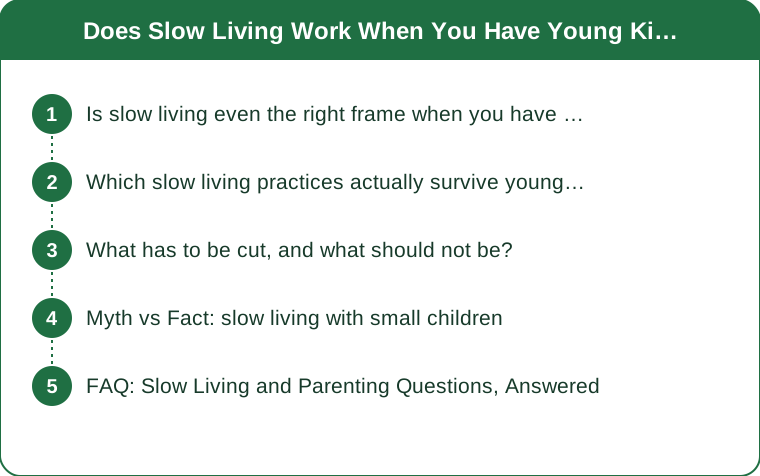
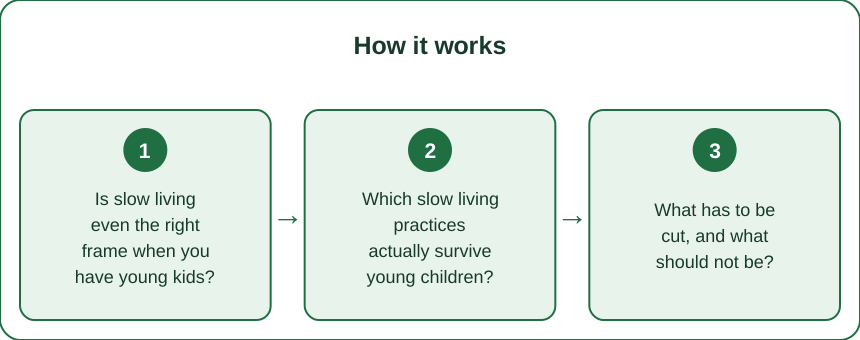
Is slow living even the right frame when you have young kids?
Partly. The core claim of slow living — that most of us do more things, more shallowly, than we would choose — holds up regardless of who lives in your house.
What does not hold up is the assumption underneath most of the writing about it: that you own your calendar. With a toddler, roughly 70 percent of your waking hours are non-negotiable and non-reschedulable. Meals happen when they happen. Naps happen or catastrophically do not. There is no productivity system that makes a 5:40am wake-up into a slow morning.
So the useful reframe is this: slow living with small children is not about reducing the number of things in the day. It is about reducing the number of things happening simultaneously. The exhaustion of early parenthood is rarely about volume alone — it is about the constant overlap. Making lunch while answering a work message while refereeing a dispute over a toy is three tasks in one minute, and that is what leaves you flattened by 8pm.
So is the answer just to lower expectations?
No — that is the version that makes people quit. Lowering expectations is passive. What actually works is choosing where the slowness goes, deliberately, and letting the rest be genuinely fast.
Which slow living practices actually survive young children?
Does single-tasking work when someone needs you every four minutes?
Better than you would think, because the interruptions are not the problem — the stacking is. Making breakfast only makes breakfast. Phone in another room. When a child interrupts, that becomes the task for ninety seconds, then breakfast resumes.
The measurable difference is not time saved; it is that a day of sequential tasks leaves you noticeably less depleted than a day of overlapped ones, even when the total task count is identical.
Do transition buffers help?
This is the highest-return change most parents can make. Add 15 minutes to every departure and every arrival. Almost all household friction with small children happens at transitions — leaving the house, coming home, moving from play to meal, meal to bath.
The rush at a transition is what turns a fine day into a shouting one. Fifteen minutes of margin is not slow living in any romantic sense, but it is the single change parents report as most transformative.
What about the morning routine everyone recommends?
Realistic version: pick one thing, and attach it to something that already happens. Coffee drunk sitting down instead of standing. Five minutes at the window before anyone else is up, if your child’s schedule allows it and not if it costs you sleep. A 90-minute morning routine is not a goal deferred; it is a goal that belongs to a different life stage, and treating it as a failure is corrosive.

What has to be cut, and what should not be?
Should you cut daily tasks or recurring commitments?
Recurring commitments, almost always. Parents tend to attack the daily list — fewer dishes, simpler meals, less tidying — and that list is largely fixed. Small children generate a floor of work that cannot be optimized away.
What is genuinely optional is the standing layer: the weekly activity your child is ambivalent about, the volunteer role, the group chat obligation, the birthday party you all dread. Cutting one recurring weekly commitment returns more time and mental bandwidth than a month of efficiency tweaks, because it removes the planning, the transport, and the anticipation, not just the hour itself.
Is it worth cutting children’s activities?
Often yes, and it is the one most parents feel guiltiest about. A single scheduled activity per child per season is a defensible default under about age seven. Unstructured time is not a deficit; it is where a lot of the developmental work happens, and it is also the only version of a slow afternoon available to you right now.
What should not be cut?
Anything that is actually restorative for you, even if it looks indulgent. The instinct under pressure is to cut your own things first because they seem optional. They are the ones holding the structure up.
Myth vs Fact: slow living with small children
Myth: Slow living means a calm household. Fact: It means a deliberate one. Households with young children are loud and chaotic and that is not a failure of the philosophy. Deliberate can be very noisy.
Myth: You need to get up before your children to have a slow morning. Fact: If getting up at 5am costs you sleep you cannot afford, it is a net loss. Sleep is the foundation everything else rests on, and trading it for a quiet hour is usually a bad trade in the under-five years.
Myth: This is a season to endure until things calm down. Fact: Some of it is genuinely a season. But treating four years as a waiting room means missing them. The practices above are worth doing now, not because they make it easier to survive, but because sequential attention is how you actually experience the time.
Myth: A minimal home makes life slower. Fact: Less stuff helps with tidying, but the constraint on your time is a small human, not your possessions. Decluttering is a fine project and a poor substitute for cutting a commitment.
Myth: You are doing it wrong if it feels hard. Fact: Everyone with a toddler finds this hard. The comparison set in most slow living content does not include people in this stage.
FAQ: Slow Living and Parenting Questions, Answered
How do I do this when my partner is not on board?
Start with the transition buffers, because they visibly reduce conflict and require no philosophical agreement. Fifteen minutes earlier out the door is not a lifestyle position; it is just a calmer morning, and it tends to sell itself within a week.
What if my work does not allow any slowness at all?
Then the sequencing happens at home, in the hours you control, and you protect the boundary between the two rather than trying to slow the work down. The most valuable version for people with demanding jobs is often a hard stop — a defined moment when work ends — rather than a slower workday.
When does it get easier?
Most parents report a noticeable shift around ages six or seven, when children can occupy themselves for meaningful stretches and transitions stop requiring physical management. That is a real change, not wishful thinking — but the habits you build now are what you will carry into it.
TL;DR:
- Slow living with young children is about sequencing, not scheduling — one thing at a time rather than fewer things.
- The three practices that survive: single-tasking, 15-minute transition buffers, and cutting recurring commitments instead of daily tasks.
- Cut the standing weekly obligations, not your own restorative time, and not sleep.
- The empty-room aesthetic belongs to a different life stage. Losing it is not failing at this.
The version of slowness available to you right now is smaller and much less photogenic than the one in the books. It is also, on most days, the one that actually works.
Keep Reading
This article is for general informational and styling purposes only. Fit, sizing, and product availability may vary.