How Do You Keep Slow Living Going When Your Schedule Suddenly Gets Busy?
Quick Answer: Slow living fails during busy periods because most people build it out of time-dependent rituals — a long morning, an unhurried walk, an evening with nothing in it. Those are the first things a busy week takes. What survives is attention-dependent, not time-dependent: doing one thing at a time, transitions with a pause in them, and a single anchor that takes under five minutes. Shrink the practice rather than suspending it.
For three weeks it worked beautifully.
Then one busy fortnight arrived and all of it vanished.
The practice was not weak. It was built out of the wrong material.

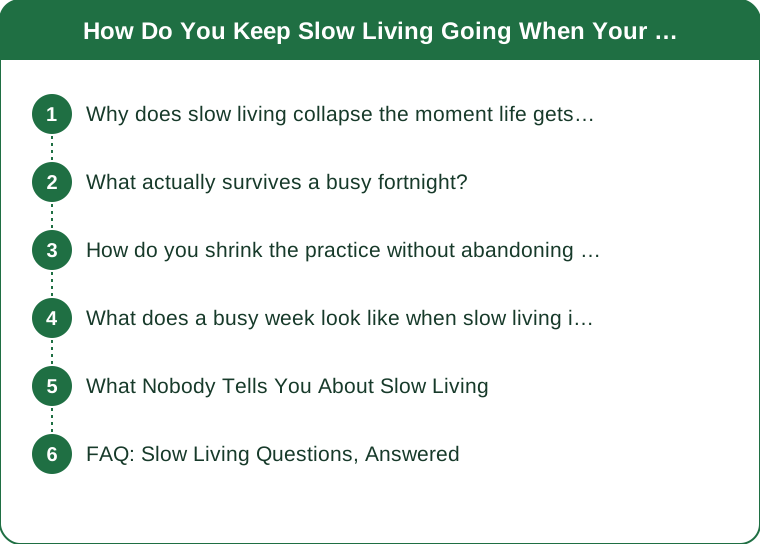
Why does slow living collapse the moment life gets busy?
Because of what it was made of.
Most slow living practices are time-shaped. A slow morning, a long walk, an evening with nothing scheduled. All of them require a resource that a busy period removes entirely.
It gets classified as optional. When the week tightens, everything gets sorted into essential and non-essential, and a practice framed as a luxury loses that sort every time.
The all-or-nothing framing kills it. If the practice is a 40-minute morning, a day with 6 minutes reads as a failed day. Two failed days in a row and people stop.
It is often aesthetic rather than functional. A practice built around linen, ceramics and good light needs a setting. A practice built around attention needs nothing.
And the busy period is exactly when it would help most. The weeks you drop it are the weeks the pace is actually damaging. The practice inverts precisely when you need it.
The reframe that fixes it: slow living is not an amount of time. It is a relationship to whatever time you have — one thing at a time, fully, instead of three things at once, partly. That definition survives a 12-hour day.
What actually survives a busy fortnight?
Practices that cost minutes rather than hours.
One thing at a time. Drinking coffee without a screen. Walking without a podcast. Eating lunch away from the desk. Costs no additional time — it changes how existing time is spent.
A pause at transitions. Sixty seconds in the car before going into the house. Three breaths before opening the laptop. Transitions happen anyway; putting a gap in them is free.
One five-minute anchor. Something that happens every day regardless — tea before anyone else is up, five minutes on the step in the evening. Small enough that a bad day cannot remove it.
Doing one ordinary task deliberately. Washing up by hand without music. Making the bed properly. The task exists on the list already; doing it with attention converts a chore into practice.
Saying one no per week. The only structural item on the list, and the one with the largest effect over a month.
A single-sentence note at night. Not journalling. One line about what the day was actually like. Takes 30 seconds and does most of what a longer practice does.
How do you shrink the practice without abandoning it?
Decide the minimum version in advance, before you need it.
Name your non-negotiable now. Choose the one element that happens on every day including the worst ones. Make it small enough to be plausible on a 12-hour day — under five minutes.
Write down the busy-week version. If your normal practice is a 30-minute morning, define the 5-minute version explicitly. Having it pre-decided means you shrink rather than skip, because you are not making the decision while exhausted.
Attach it to something that already happens. Anchor it to the kettle, the commute, the school run, closing the laptop. Practices attached to existing events survive; free-floating ones do not.
Drop the aesthetic requirements. The tea does not need the good cup. The pause does not need the good chair. Anything that requires a setting will be skipped when the setting is unavailable.
Expect the return, and do not audit it. After a busy period, resume the fuller version without reviewing how badly the fortnight went. The review is what turns a gap into an ending.
Seasonal note: late August into September is one of the two predictable collapse points in the year — schedules restart, evenings shorten, and the practice built around a light 8pm garden stops fitting by the end of the month. Move the anchor indoors and earlier before the light goes, rather than discovering in October that it has quietly stopped.

What does a busy week look like when slow living is built right?
Concrete, because the abstract version is what makes this hard to apply.
Morning is 7 minutes, not 40. Kettle on. Stand at the window while it boils. Drink the first half of the tea without a phone. That is the whole thing, and it is genuinely enough.
The commute is single-tasked once. One journey a day without audio. Not all of them — one.
Lunch is eaten, not consumed while working. Even 10 minutes away from the screen. This is often the largest available improvement in a working day and the most commonly skipped.
Transitions get a breath. Before the meeting, before the front door, before the reply. Three breaths, no ceremony.
One task gets done deliberately. The washing up, the folding, the walk to the postbox. Something that was going to happen anyway.
The evening has one uninterrupted thing in it. Even 15 minutes. Reading, sitting outside, a phone call with someone you like.
What people notice after two weeks of this
The busy period feels less like a blur. Attention, not duration, is what makes time memorable.
The practice stops feeling fragile. Once it has survived one hard fortnight, it stops being conditional.
The fuller version returns on its own. When space appears, the habit expands into it without effort, because it never stopped.
What Nobody Tells You About Slow Living
It is not the opposite of busy. People with genuinely full lives practice it. The opposite of slow living is divided attention, not a full calendar.
The aesthetic is a trap. Linen, ceramics and good morning light photograph well and have nothing to do with the practice. Building around them makes it fragile and slightly performative.
Doing less is often unavailable, and that is fine. Caregiving, two jobs, small children — none of that can be reduced by choosing. The practice has to work inside the constraint, not require its removal.
Five minutes genuinely does something. This sounds like a consolation prize and is not. A daily five minutes outperforms an occasional unhurried Sunday by a wide margin, because it is the consistency that changes your baseline.
The hardest part is single-tasking, not slowing down. Most people can walk slowly. Very few can walk without listening to anything.
And the one that surprises people: the busy fortnight is where the practice is actually built. A morning ritual that only exists on quiet weeks has never been tested. The one that survives October is the one you will still have next year.
FAQ: Slow Living Questions, Answered
Is slow living realistic with a demanding job?
Yes, if it is built from attention rather than time. The version requiring an empty morning is not realistic for most people, and it is also not the only version.
What is the smallest practice worth doing?
One five-minute anchor and a pause at one daily transition. That is a complete practice, not a reduced one.
How long before it makes a difference?
Most people notice within two weeks — usually as a sense that the days are less blurred rather than as calm.
What if I miss several days?
Resume without reviewing the gap. Auditing a lapse is what converts a pause into an ending.
Does it need to be in the morning?
No. Attach it to whatever point in your day is most reliably yours. For some people that is 9pm.
Is single-tasking the same as mindfulness?
Overlapping but simpler. You do not need a formal practice — you need to stop doing two things at once, once or twice a day.
What is the most common reason people quit?
Building it too large. A 40-minute practice has a much higher failure rate than a 5-minute one, and the 5-minute one produces most of the benefit.
TL;DR:
- Slow living collapses in busy weeks because it is usually built from time, which busy weeks remove.
- Rebuild it from attention: one thing at a time, a pause at transitions, one small daily anchor.
- Define the five-minute busy-week version in advance so you shrink rather than skip.
- Anchor it to something that already happens and drop every aesthetic requirement.
- The fortnight you nearly quit is where the practice actually gets built.
Pick your one non-negotiable this week and make it small enough to survive your worst day. That is the whole method.
Keep Reading
This article is for general informational and styling purposes only. Fit, sizing, and product availability may vary.