How Do You Keep Slow Living When Everyone Around You Speeds Up?
Quick Answer: You cannot hold a slow pace by willpower inside a fast system, because pace is contagious and mostly transmitted through commitments other people make on your behalf. What works is protecting structure rather than mood: a small number of fixed non-negotiables, a default response that buys time before you agree to anything, and an accepted quota of things you will do badly. Slow living in a fast season is a set of boundaries, not a feeling.
The honest version of this is less serene than the pictures suggest, and considerably more durable.
This blog has covered whether slow living survives the September reset, whether it can work with a demanding job, and why slow mornings fail by Wednesday. This one is about the part other people control.

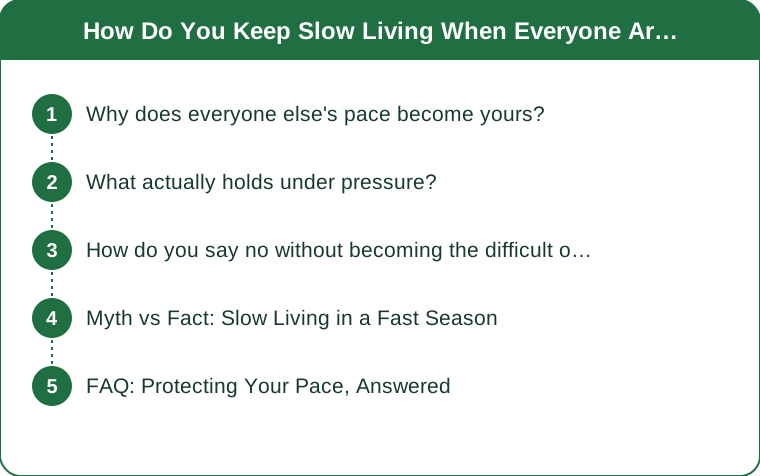
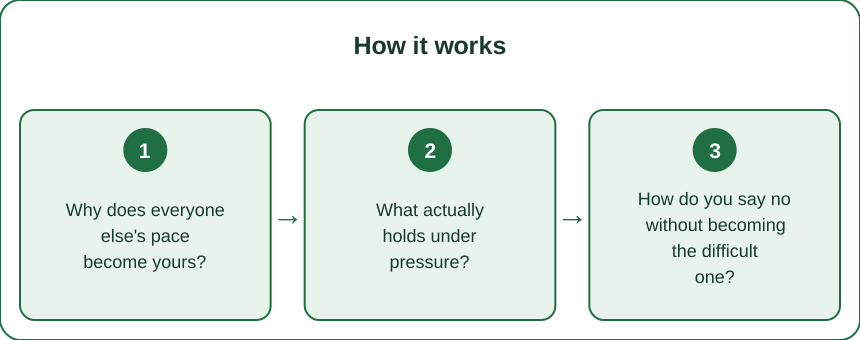
Why does everyone else’s pace become yours?
Because most of your calendar is written by other people, and pace transmits through commitments rather than through attitude.
Roughly speaking, the average adult directly chooses a minority of what happens in a given week. Work rhythms, school calendars, family events, and other people’s deadlines fill the rest, and none of them consult your preferred tempo.
Speed spreads through obligation, not mood. You do not get busy because you caught someone’s energy. You get busy because they committed you to three things.
Autumn concentrates this. School terms restart, work quarters begin, social calendars reopen after summer, and annual planning cycles kick off — often all within a fortnight.
Urgency is also socially rewarded, so the person who says yes fast is read as reliable, and the person who pauses is read as difficult. That asymmetry is the actual pressure.
And your own guilt does the last part. Most people speed up not because they were forced to but because declining felt worse than being tired.
Which tells you where the leverage is. Not in feeling calmer. In the moment between a request and an answer.
What actually holds under pressure?
Structure holds. Intentions do not.
Pick three non-negotiables, not a lifestyle. Three specific, time-bounded things — Sunday afternoon unscheduled, no work email after eight, Thursday evening free — survive a busy season. A general aspiration to live slowly does not survive a single week.
Put them in the calendar as commitments, not gaps. Empty time reads as available to everyone including you. Named time does not.
Use a default holding response. “Let me check and come back to you tomorrow” is one sentence, costs nothing socially, and removes the reflex yes that causes most overcommitment.
Decide your quota of bad-enough in advance. Pick the two or three areas where a mediocre job is acceptable this season and do them mediocrely on purpose. Unchosen mediocrity feels like failure; chosen mediocrity feels like a plan.
Batch the fast things together. Four errands in one afternoon protects three other afternoons. Spreading them evenly makes every day feel rushed.
And protect the transitions, not just the blocks. Ten minutes between things is what makes a full day feel survivable, and it is the first thing that gets deleted.

How do you say no without becoming the difficult one?
By changing what you decline rather than how firmly you decline it.
Decline the format, not the person. “I can’t do dinner but I’d love a walk on Saturday” keeps the relationship and drops the three-hour commitment. Most social invitations are about contact, not the specific activity.
Be specific about what you can do. A vague no invites negotiation. A precise alternative ends it.
Do not explain at length. Long explanations read as requests for permission and invite counterarguments. One clause is enough and is generally accepted without comment.
Decline early rather than well. A no two weeks out costs almost nothing. The same no two days out costs a great deal, which is why the holding response matters so much.
Accept that some people will be annoyed. A small amount of disappointment is the actual price of a protected schedule, and there is no version where you pay nothing.
And drop the word busy. “I’m not free” is a fact. “I’m so busy” is a competitive claim that invites the other person to prove they are busier, which is how the whole conversation accelerates.
Myth vs Fact: Slow Living in a Fast Season
Myth: Slow living means doing fewer things. Fact: It means fewer things happening at once, with space around them. A full week with margins feels slow; a half-empty week of back-to-back commitments does not.
Myth: If you really valued it, you would protect it. Fact: Most pace loss is structural, not motivational. Blaming your commitment level for a calendar other people wrote is both inaccurate and demoralising.
Myth: You need to leave your job or move somewhere quieter. Fact: Those are large changes with mixed results. Three defended weekly non-negotiables reliably outperform a fantasy relocation that never happens.
Myth: Saying no damages relationships. Fact: Declining a format while offering an alternative preserves nearly all of them. What damages relationships is showing up resentful and depleted.
Myth: Slow mornings are the foundation. Fact: For most people mornings are the least controllable part of the day. Protected evenings and one protected weekend block are far more defensible.
Myth: When this busy period ends, it will settle down. Fact: There is always another period. Whatever you can only do when things calm down is functionally something you have stopped doing.
FAQ: Protecting Your Pace, Answered
How do I keep a slow pace when my family’s schedule is packed?
Stop trying to slow the whole week and defend specific blocks instead. Two or three named, calendared non-negotiables survive a packed season, and they give the rest of the week something to bend around.
Is it selfish to protect my time when everyone else is stretched?
No, and the framing is worth rejecting. A person with some margin is more useful to the people around them than one running on empty. The genuinely selfish version is agreeing to everything and then being resentful about it.
Does slow living mean I have to turn down invitations?
Usually you can decline the format instead of the person. “I can’t do dinner but I’d love a walk on Saturday” keeps the relationship and removes a three-hour commitment, and most invitations are about contact rather than the specific activity. Declining two weeks out costs almost nothing socially; declining two days out costs a great deal, which is the real argument for answering slowly.
What do I do when the busy season lasts for months?
Treat it as the normal condition rather than an exception to survive. Pick the areas where you will deliberately do a mediocre job, protect your three blocks, and stop waiting for a calm period to start living at your preferred pace.
TL;DR:
- Pace transmits through commitments other people make, not through mood, which is why willpower alone never holds it.
- Three named, calendared non-negotiables beat a general intention to live slowly.
- A holding response — “let me come back to you tomorrow” — removes most overcommitment at the source.
- Choose your mediocre areas in advance. Chosen mediocrity is a strategy; unchosen mediocrity feels like failing.
The pace you keep in a fast season is decided in the two seconds before you answer. That is the whole practice.
Keep Reading
This article is for general informational and styling purposes only. Fit, sizing, and product availability may vary.