Is It Still Slow Living if You Have to Schedule It?
Quick Answer: Yes - scheduling slow time is not a contradiction, because the enemy of slow living is not structure, it is reactivity. An unscheduled hour in a life full of obligations gets consumed by whoever asks first. Protecting time on a calendar is what makes unhurried time survive contact with a normal week. What ruins it is scheduling the content of the hour, not the hour itself.
You are not scheduling relaxation.
You are building a fence around it and then leaving the inside empty.
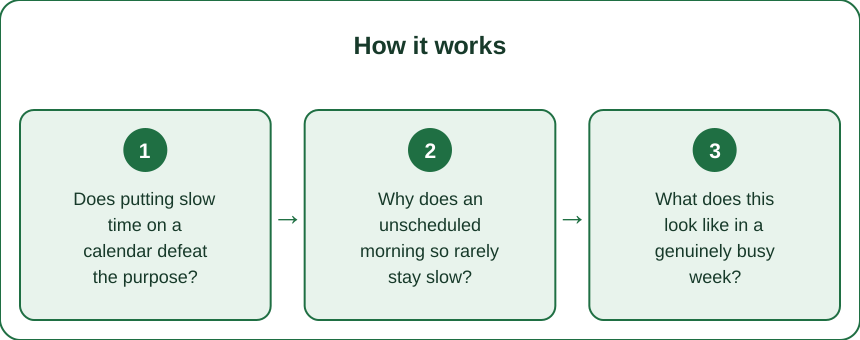
Does putting slow time on a calendar defeat the purpose?
No - and the reason exposes a common misreading of what slow living is for.
Slow living is about who decides how your time is used, not about how full it is. A packed day you chose feels entirely different from an empty day you spent responding to other people. The core problem is reactivity: time going to whatever demand arrived most recently and most loudly.
Unclaimed time is not free time - it is available time. In practice, an unbooked Saturday morning does not stay unbooked. It gets filled by the errand someone remembers, the call someone reschedules, the task that migrated from Friday. Blocking it is the only thing that makes it real.
The distinction that matters is between scheduling a container and scheduling its contents. Booking 8 to 9.30 on Sunday morning as unstructured is slow living. Booking 8.00 meditation, 8.20 journal, 8.40 stretch, 9.00 reading is a to-do list wearing a dressing gown.
Test it against how you feel at the end. If the block leaves you slightly ahead of where you started, it worked. If you finished it and felt behind on the block itself, you scheduled contents.
Does the block need to be long?
No. Ninety minutes protected beats four hours theoretically available. Most people who say they have no time for slow living actually have several unprotected hours a week that never survive.
What if something urgent lands in the block?
Move it, do not delete it. A block that gets moved twice and still happens is a functioning system; a block that gets deleted was never protected.
Why does an unscheduled morning so rarely stay slow?
Because open time has no defence against other people’s structure.
Everyone else’s requests arrive with a time attached. A meeting invite, a delivery window, a school pickup, a friend suggesting 10am. Your unstructured intention has no time attached, so it always loses the negotiation.
Decision fatigue eats the front of an open block. Standing in the kitchen deciding what to do with a free morning burns twenty minutes and often ends with the phone. A block with a rough intention - outside, or reading, or nothing in particular - removes the opening decision without filling the hour.
Open time also fills with maintenance. Laundry, dishes, and admin expand to occupy any space, because they are always mildly urgent and never actually finished. A block that is not named gets used by chores by default.
And the phone is the fastest filler of all. Unstructured time with a device in reach reliably becomes scrolling, which produces none of the recovery that slow time is meant to produce.
So should the block have a name?
A loose one. Outside, or read, or cook something unhurried - broad enough to leave choice, specific enough to stop the twenty-minute negotiation.
What about spontaneity?
Spontaneity works when there is space for it to happen in. A protected block is where spontaneous things fit - the unplanned walk almost never appears in a fully booked day.

What does this look like in a genuinely busy week?
Smaller and more boring than the aesthetic suggests, which is why it survives.
Start with one block, not a routine. One protected stretch a week, in a slot that is already historically quiet. Sunday morning before the house wakes, Wednesday evening, the hour after school drop-off. A single reliable block beats a beautiful daily plan that collapses by Wednesday.
Attach it to something that already happens. The block after the weekly shop, or after the Friday call, or before the Saturday sport run. Existing anchors make new blocks stick without willpower.
Defend it in the smallest way possible. Marked as busy on a shared calendar, phone in another room, and a single sentence ready for when someone asks - I have got something then, can we do the afternoon.
Let the contents change every time. The point is the protected space, not the ritual inside it. A block that becomes a fixed routine has quietly turned back into a schedule.
And keep it in the same slot for at least a month. Moving it around each week means renegotiating it each week, which is the exact cost you were trying to avoid.
How is this different from just having a hobby?
A hobby is a specific activity with its own expectations and progress. This is deliberately non-productive - the value is in the absence of a required outcome.
Does it work if you have young children?
Only if it is short and shared with another adult, or if it happens in the gap the household already has. Twenty protected minutes is a realistic target with small kids - and it still works.
What Nobody Tells You About Slow Living
The first few protected hours feel uncomfortable, not restful. Unstructured time exposes how used to constant input you are, and the initial reaction is usually restlessness or guilt. This passes in about three sessions, but plenty of people quit before it does.
Slow living is expensive in a way nobody advertises. Not financially, in trade-offs - saying no to something real. Every protected hour comes out of another hour, and the version that requires no sacrifice is usually just aesthetic photos of linen.
Doing it well often looks like doing less well. Answering messages more slowly, being less available, being the person who does not respond that evening. If nothing about your responsiveness changed, the slow time probably came out of your sleep.
The busiest people benefit most and adopt it least. The threshold for feeling entitled to protected time rises exactly as free time shrinks, which is precisely backwards.
It works better in company than alone. A protected block that another person also holds - a partner, a friend, a housemate - survives far longer than a private intention nobody else knows about.
And the aesthetic is a distraction. Linen, ceramics, and a clean kitchen have nothing to do with the mechanism. The mechanism is a boundary, and boundaries look like nothing in photographs.
FAQ: Slow Living and Structure, Answered
Is slow living just a privileged version of having free time?
Partly, and it is worth being honest about that - people with rigid shifts and caring duties have far less room to protect. But the core move, deciding rather than reacting, scales down to a twenty-minute block, and that version is available to most people.
How do I stop feeling guilty during protected time?
Guilt usually comes from the sense that the time is stolen from something. Deciding in advance what it is coming out of - one less evening of catching up on work, one fewer errand on Saturday - converts a vague theft into an explicit trade, which is much easier to sit with.
What if my block keeps getting cancelled?
Then it is in the wrong slot. Look at the last month and find the hour that nothing ever landed on - that is your slot. Fighting for a popular hour is how most attempts die.
TL;DR:
- Scheduling slow time is not a contradiction - the enemy is reactivity, not structure.
- Schedule the container, never the contents. A minute-by-minute morning routine is a to-do list.
- Unprotected time gets used by other people, chores, and the phone, in that order.
- Start with one weekly block attached to an existing anchor, and keep the slot for a month.
- The first sessions feel restless, not restful. That is normal and it passes.
Pick the hour nothing ever lands on and put a fence around it this week. Leave the inside empty on purpose.
Keep Reading
This article is for general informational and styling purposes only. Fit, sizing, and product availability may vary.