Is Slow Living Possible With a Full Time Job and Young Kids?
Quick Answer: Yes, but not the version in the photographs. Slow living with a job and small children is not about having unhurried hours; it is about reducing the number of transitions, decisions, and background obligations that make a day feel frantic. The pace of a day is set more by how many times you switch tasks than by how much you do. That is changeable even when your schedule is not.
You cannot buy time. You can lower the density of the time you have.

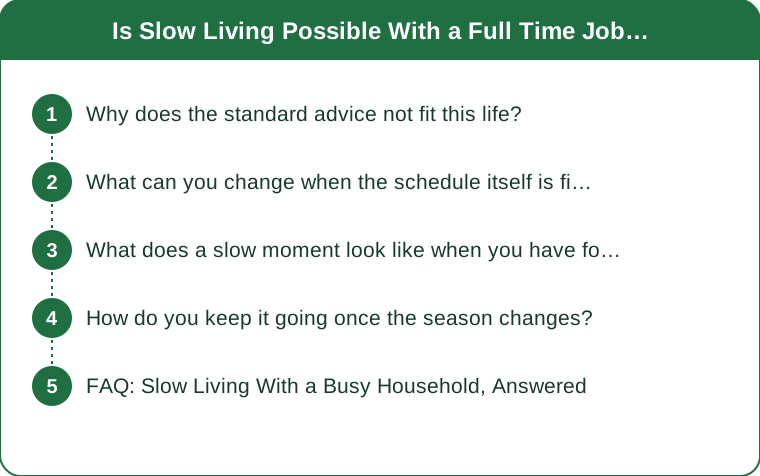
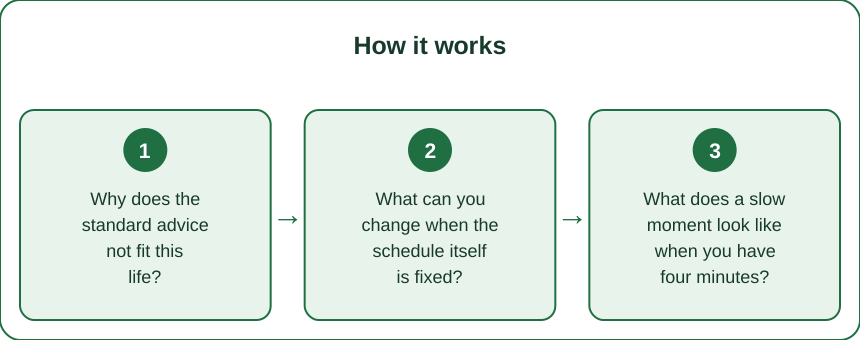
Why does the standard advice not fit this life?
Because most of it solves a problem you do not have.
The familiar prescriptions, unhurried mornings, single tasking, long walks, are aimed at people whose days contain discretionary blocks they are filling badly. If your day is genuinely fully committed from six in the morning until eight at night, there is no block to reallocate, and being told to spend an hour differently reads as a description of someone else’s life.
What these lives actually contain is not too many hours spent badly. It is too many transitions. Wake, wake others, dress, feed, pack, drive, switch into work, switch out for a call, switch back, collect, cook, referee, bathe, settle, and then attempt to be a person for forty minutes.
That matters because switching is where the cost is. Attention research is consistent that shifting between tasks carries a resumption cost, and it is heaviest when the switch is unplanned. A day of twenty five task switches feels frantic even if the total work is modest, and a day of six feels calm even if it is objectively fuller.
So the honest reframing is this. You are not short of slowness because you lack hours. You are short of it because your hours are fragmented. Fragmentation is partly imposed and partly self inflicted, and the self inflicted part is larger than most people expect.
That is the part that is available to you.
What can you change when the schedule itself is fixed?
Four things, none of which require finding extra time.
Cut the number of decisions. Deciding is the tax that makes a full day feel heavier than it is. Fixed weekday breakfasts, a short repeating dinner rotation, laid out clothes, a standard bag that is always packed the same way. Each decision you retire is one less small negotiation in a day that has too many. This is why people who seem calm often have startlingly repetitive routines.
Batch the transitions. Two supermarket runs and three separate errands is five switches; one loop is one. Answering messages at three set points rather than continuously is a genuine change in how a day feels, and it is close to invisible to everyone else.
Protect one boundary rather than several. Trying to build calm across the whole day fails immediately. One reliably protected block, twenty minutes, at the same point each day, is worth more than an aspiration to be unhurried generally. For most people it is the first twenty minutes before anyone else is up, or the first twenty after the last child is down.
Reduce the background list. A significant part of feeling rushed is carrying unresolved items rather than performing tasks. Writing them down genuinely lowers the load, because held items keep re announcing themselves and written ones do not.
What consistently does not work: trying to slow down during the parts of the day that cannot be slowed. The school run is not a candidate for mindfulness. Give it up and spend the effort on the parts that are actually flexible.

What does a slow moment look like when you have four minutes?
Small, structural, and unglamorous. Here is what people who manage it actually do.
They finish one thing before starting the next, even when the thing is trivial. Putting the mug down, in the dishwasher, before opening the laptop. The feeling of a rushed life comes largely from a chain of half completed actions, and closing them costs nothing.
They keep one activity that is not optimised. Not exercise that is also social, not a podcast that is also educational. One thing that is only itself, and it can be brief. Compounding every activity with a second purpose is what makes a full life feel like a schedule.
They use the natural pauses that already exist. The four minutes while the kettle boils, the two minutes in the car after arriving, the wait at pickup. These are not fragments to be filled with a phone; they are the only unstructured time in the day, and reclaiming them changes the texture of it more than an aspirational hour that never materialises.
They let some things be done badly on purpose. A decided, deliberate standard drop, cereal for dinner on Wednesdays, is different from failing at an intended standard. Same outcome, completely different experience.
They stop measuring against a version of the day that was never possible. A lot of the exhaustion is the gap between the day you had and the day you pictured. Adjusting the picture is faster than adjusting the day.
How do you keep it going once the season changes?
By expecting the difficult points rather than being surprised by them, because they arrive on a fairly predictable schedule.
The return to school and routine is the hardest transition of the year for households with children, and right now most people are in it. New timetables, new activities, and a fresh set of commitments arrive at once, and the natural response is to accept all of them and then feel overrun by October.
What helps, specifically:
Decide the activity ceiling before the invitations arrive. How many weekday evening commitments the household can hold, decided calmly in August, is a much better number than the one you arrive at by accretion in November. Adding is easy and removing is socially awkward, so the ceiling has to be set in advance.
Move the protected block earlier as the light goes. Evening blocks are the first casualty of dark afternoons, because the day has already collapsed by then. A block that survives December is usually a morning one.
Expect the routine to break every few weeks and plan the restart, not the streak. Illness, travel, and school holidays will interrupt anything. The people who sustain this are not the ones who never lapse; they are the ones with a low friction way back in.
Watch for the autumn tendency to add rather than substitute. New season, new intentions, and the existing commitments never get removed. Slow living in a full life is subtraction. It is almost never addition.
And one thing worth saying plainly: if the pace is not just tiring but genuinely unmanageable, if you are not sleeping, or if the load has stopped feeling survivable, that is a different problem and it is not solved by routine design. Talking to a doctor or a counsellor about it is a reasonable step, not an overreaction.
FAQ: Slow Living With a Busy Household, Answered
Is slow living just a privilege?
The photographed version largely is. The mechanism underneath, fewer decisions, fewer transitions, one protected boundary, is not, and it does not depend on income or free hours. It does depend on being allowed to make some choices about your own routine, which not everyone is.
How do you slow down with a toddler who sets the pace?
You do not slow the child. You reduce everything around the child, fewer errands, fewer commitments, more repetition. Small children respond well to predictable days, so this is one of the rare cases where what helps you helps them directly.
Does this mean doing less overall?
Usually a little less, and mostly fewer separate things. Three commitments done properly generate less friction than six done partially, even when the total hours are identical.
Where should someone start with almost no time?
One repeating decision retired, this week. Same weekday breakfast, or clothes laid out the night before. It is a small enough change to survive a bad week, and it is the only kind that lasts.
TL;DR:
- Frantic days come from fragmentation and constant task switching, not from a shortage of hours, and fragmentation is partly within your control.
- Retire repeating decisions, batch transitions and messages, and protect one twenty minute block rather than the whole day.
- Use the pauses that already exist, close small actions before starting new ones, and keep one activity that serves only one purpose.
- Set your household’s commitment ceiling now, before the autumn schedule fills itself in.
Pick the single decision you make every weekday morning and make it once, permanently, this week. That is the whole starting point.
Keep Reading
This article is for general informational and styling purposes only. Fit, sizing, and product availability may vary.