Is Slow Living Actually Realistic With a Demanding Full-Time Job?
Quick Answer: Slow living principles can genuinely apply within a demanding job, but the practice looks different — smaller, more concentrated moments of intentionality (a phone-free morning routine, a mindful commute, a slower evening wind-down) rather than the spacious, unstructured days often shown in slow living media, which are more realistic for people with significant schedule flexibility than for most full-time workers.
Is slow living realistic with a demanding job? Yes, but not in the form most commonly pictured — it has to shrink down to fit the actual hours available, rather than being abandoned as impossible.

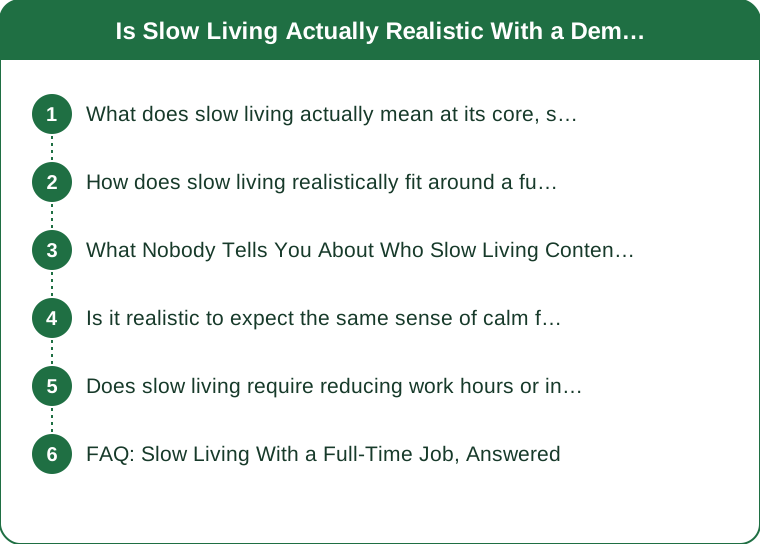
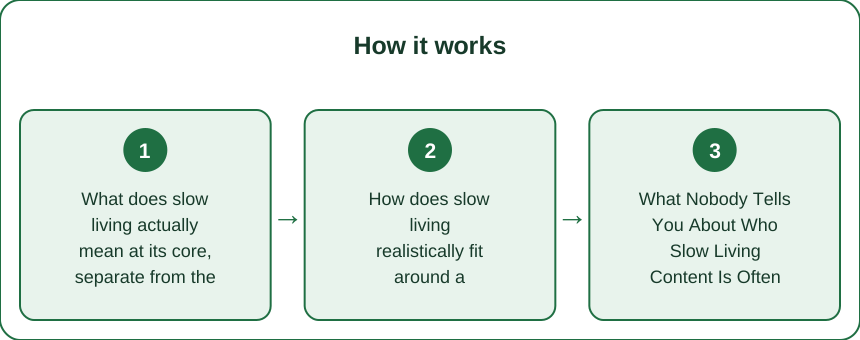
What does slow living actually mean at its core, separate from the aesthetic?
At its core, slow living is about intentionality and presence — doing fewer things with more attention rather than rushing through many things distractedly — and this underlying principle doesn’t inherently require large amounts of free time; it requires choosing where limited attention goes, which is arguably more achievable, not less, within genuine time constraints.
How does slow living realistically fit around a full-time job’s actual schedule?
Rather than requiring hours of unstructured time, practical slow living for a busy schedule concentrates into smaller windows — a phone-free 15-minute morning coffee before checking email, a walk during a lunch break instead of scrolling, an intentional wind-down routine in the final hour before bed — treating these as meaningful anchors rather than needing an entire slow-paced day to count.
What Nobody Tells You About Who Slow Living Content Is Often Made By
Much visible slow living content is created by people with flexible schedules — freelancers, content creators, or those in a position to build their work around the lifestyle rather than the reverse — and nobody tells you this contextual difference explicitly, which can make the practice look inaccessible or performative to someone comparing their demanding 9-to-5 reality against a curated, unrepresentative daily schedule.

Is it realistic to expect the same sense of calm from a compressed version of slow living?
The scale of calm achieved is proportional to the time and consistency invested, so a 15-minute intentional morning won’t produce the same cumulative effect as a fully unstructured day, but consistent smaller practices still provide genuine, measurable benefit over time — the comparison to worry about isn’t the compressed version versus the full-day version, but the compressed version versus no intentional practice at all.
Does slow living require reducing work hours or income to be meaningful?
No — while some people do choose to restructure work for more time, the core practice of intentionality and presence doesn’t require income or hour reduction to provide benefit; someone can meaningfully practice these principles within existing full-time work constraints, making significant lifestyle or income changes optional rather than a prerequisite.
FAQ: Slow Living With a Full-Time Job, Answered
What’s a realistic first step for someone with almost no spare time to try slow living?
Picking one single daily transition point — like the first ten minutes after waking or the commute home — and protecting it as phone-free and unhurried tends to be a manageable, realistic starting point rather than attempting a full lifestyle overhaul.
Does slow living conflict with career ambition or being genuinely busy?
Not inherently — slow living is about the quality of attention during available time, not the total amount of time or ambition itself, meaning it’s compatible with a demanding, ambitious career rather than requiring opting out of one.
How can someone tell if their version of slow living is actually working within a busy schedule?
A noticeable, even if modest, reduction in daily rushed or scattered feeling, and a sense of a few genuinely present moments each day, are more realistic markers of success than comparing the overall pace of the day to an unstructured ideal.
TL;DR:
- Slow living’s core principle — intentional presence — doesn’t require large amounts of free time to matter
- Small, protected windows (a phone-free morning, a mindful commute) make it achievable within full-time work
- Much visible slow living content comes from people with flexible schedules, skewing the comparison
- Consistent small practices provide genuine benefit even without a full lifestyle or income change
Slow living with a demanding job isn’t a contradiction — it’s just a smaller-scale version of the same idea, and it still counts even without the spacious, unstructured days the aesthetic usually shows.
Keep Reading
This article is for general informational and styling purposes only. Fit, sizing, and product availability may vary.