Is Slow Living Actually Realistic With a Full-Time Job?
Quick Answer: Yes — slow living with a full-time job is realistic when you apply it to small daily windows and specific choices rather than treating it as an all-day lifestyle overhaul, which is where most people get discouraged and quit.
Every slow living photo shows someone with unlimited free time. You have a 9-to-5, a commute, and a to-do list. Here’s how the actual questions people ask usually get answered.

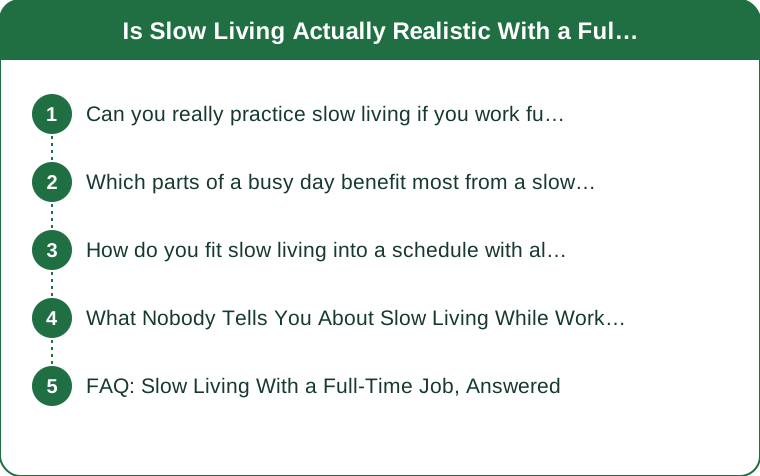
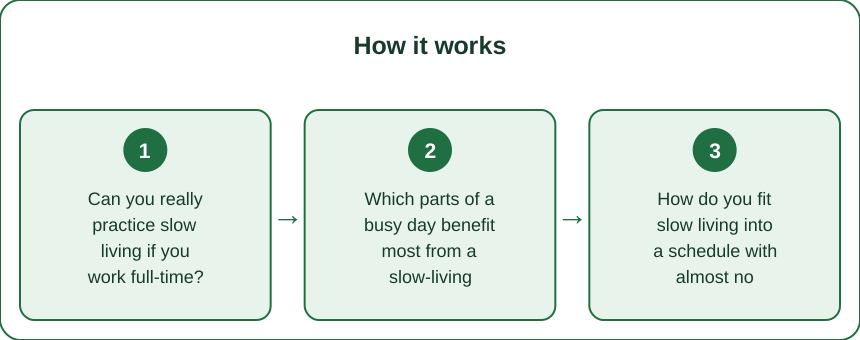
Can you really practice slow living if you work full-time?
Yes — slow living isn’t about having less to do, it’s about how you move through what you do have to do. Someone with a full-time job can still eat one meal a day without a screen, take a phone-free walk during lunch, or spend fifteen unrushed minutes in the morning instead of checking email first thing. Small, protected pockets of unhurried time count.
The misconception that slow living requires a dramatically simplified life (fewer commitments, more free hours) is what makes it feel unrealistic — in practice, most people who successfully build it in are still busy, just more intentional about specific moments.
Which parts of a busy day benefit most from a slow-living approach?
Transitions — the start of your morning, your commute, and the wind-down before bed — tend to offer the most accessible opportunities, since they’re moments you’re already experiencing regardless of how busy the rest of your day is. Choosing to experience a commute without podcast-multitasking, or a morning without immediately grabbing your phone, doesn’t require freeing up new time, just changing how existing time is spent.
Work hours themselves are harder to meaningfully “slow,” and trying to force slowness into an inherently demanding workday often just adds frustration rather than calm.

How do you fit slow living into a schedule with almost no flexibility?
Start with one single daily anchor point rather than trying to overhaul your whole day at once — most people who quit slow living attempts tried to change too much simultaneously and burned out on the effort itself. A single unhurried cup of coffee before checking your phone, or a walk without headphones, is a realistic, sustainable starting point.
Once one anchor point feels automatic (usually after a few weeks), it’s easier to add a second one, rather than starting with an ambitious full-day plan that competes directly with real job demands.
What Nobody Tells You About Slow Living While Working Full-Time
Most slow living content is created by people whose job is creating slow living content, or who have significant flexibility most full-time employees don’t have. That gap between the aspirational image and an actual 9-to-5 reality is a major reason people feel like they’re failing at something that was never designed for their circumstances in the first place.
A more honest framing: slow living for a working person isn’t a full lifestyle, it’s a set of specific, protected moments within a demanding schedule — and that version is genuinely achievable, just less photogenic than the version usually shown.
FAQ: Slow Living With a Full-Time Job, Answered
Do I need to quit my job or work less to practice slow living?
No — most people successfully build slow living habits around a full-time job by focusing on specific daily moments, not by reducing work hours.
What’s a realistic first slow-living habit to try?
One unhurried morning routine element, like coffee without your phone, is a manageable and sustainable starting point.
Is it normal to feel like I’m failing at slow living because I’m still busy?
Yes, and it’s usually a sign of comparing yourself to an unrealistic version of the concept rather than actually failing at anything.
TL;DR:
- Slow living with a full-time job means specific protected moments, not an entire slowed-down lifestyle
- Transitions like mornings and commutes are the most realistic places to start
- Build one single daily anchor point before adding more
- Most slow living content comes from people with more flexibility than a typical job allows
Pick one transition moment in your day tomorrow and protect it — that’s a realistic, sustainable version of slow living that fits an actual full-time schedule.
Keep Reading
This article is for general informational and styling purposes only. Fit, sizing, and product availability may vary.