Is Slow Living Actually Realistic When Both Partners Work Full-Time?
Quick Answer: Slow living doesn’t require unstructured free time — the core principle (intentional presence over rushed multitasking) can apply to small windows within a demanding schedule, like a fully present 10-minute morning coffee, which is a more realistic goal for two full-time working partners than adopting the broader lifestyle wholesale.
The imagery shows someone kneading bread mid-afternoon with nowhere to be. Two people working full-time jobs are looking at that same content wondering if the whole concept was ever built for their actual life.

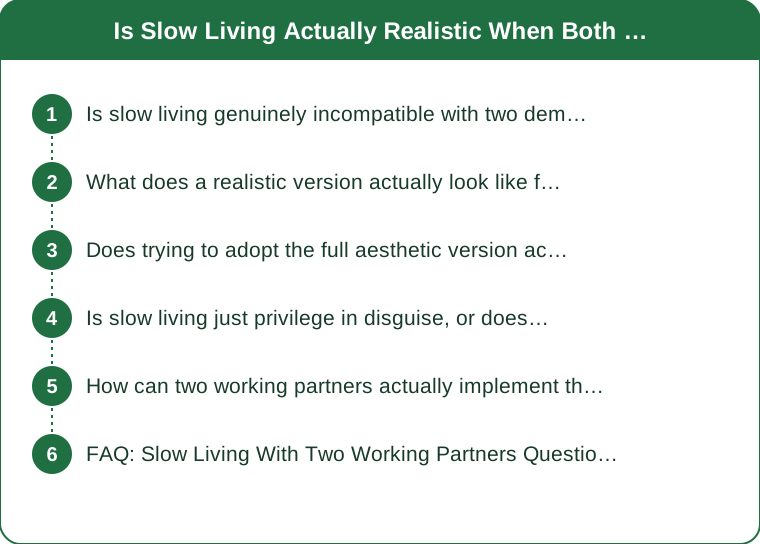
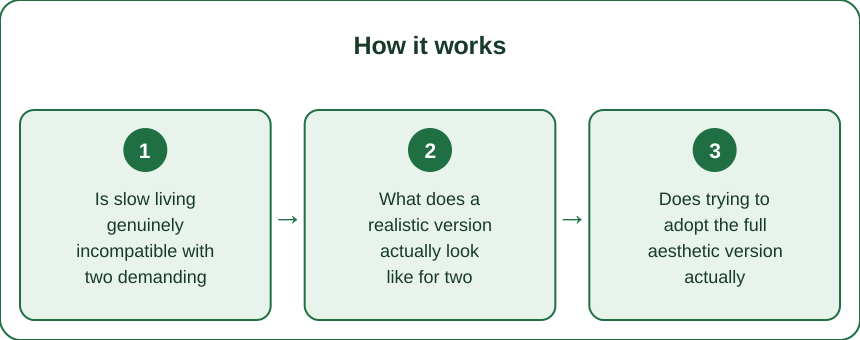
Is slow living genuinely incompatible with two demanding full-time jobs, or is that a misreading of the concept?
The core idea behind slow living is intentionality and presence, not abundant unstructured time — the visual content associated with it (leisurely mornings, elaborate home cooking, no visible schedule) reflects a specific, often financially privileged version of the concept, but the underlying principle can be applied in small, genuinely time-realistic ways that don’t require restructuring an entire demanding schedule.
What does a realistic version actually look like for two working partners?
Choosing 2-3 small daily moments — a fully present breakfast without phones, a short walk without a podcast, a genuinely unhurried five minutes before starting work — and protecting those specifically, rather than trying to slow down an entire day that structurally can’t be slowed. This targeted approach captures the psychological benefit (reduced rushing, more presence) without requiring a schedule that two full-time jobs simply doesn’t allow.
Does trying to adopt the full aesthetic version actually backfire?
Often, yes — attempting elaborate slow-living practices (long meal prep, extended morning routines) within a schedule that doesn’t have room for them tends to create additional stress and a sense of failure, which runs counter to the entire point of the practice. Scaling the concept to match actual available time, rather than the aspirational version, is what makes it sustainable rather than another source of pressure.

Is slow living just privilege in disguise, or does that critique miss something?
The critique has real merit for the aesthetic version — abundant unstructured time genuinely is a privilege not everyone has — but the critique doesn’t fully apply to the underlying psychological principle, which research on mindfulness and single-tasking supports independent of how much total free time someone has. The mistake is treating the Instagram version and the underlying principle as the same thing, when they’re not.
How can two working partners actually implement this without adding coordination overhead to an already busy life?
Choosing one shared, small ritual (a phone-free dinner, a five-minute check-in before bed) rather than each person independently trying to slow down separate parts of their day tends to work better logistically, since it doesn’t require additional scheduling coordination on top of an already demanding shared calendar.
FAQ: Slow Living With Two Working Partners Questions, Answered
Does slow living require giving up ambition or a demanding career?
No — the concept is about presence during specific moments, not a wholesale lifestyle or career change, and applying it doesn’t require reducing work hours or ambition.
Is it worth trying if only one partner is interested and the other isn’t?
Yes — an individual can practice presence-focused habits independently; it doesn’t require both partners’ buy-in to provide personal benefit, though shared moments do tend to feel more sustainable long-term.
How long before smaller-scale slow living practices actually feel noticeable?
Most people report a noticeable shift in daily stress within 2-3 weeks of consistently protecting even small intentional moments, since the benefit comes from consistency more than duration of any single practice.
TL;DR:
- The aesthetic version of slow living assumes unstructured time most working partners don’t have
- The underlying principle (presence over rushing) can scale down to small protected moments instead
- Trying to adopt the full aesthetic within a demanding schedule often backfires into more stress
- A shared small ritual is more sustainable for two working partners than separate individual efforts
Slow living was never really about how much time you have — it’s about what happens inside the time you actually protect, however small that window is.
Keep Reading
This article is for general informational and styling purposes only. Fit, sizing, and product availability may vary.