What Does Slow Living Look Like on a Bad Day?
Quick Answer: On a low-capacity day, slow living stops being about adding calm rituals and becomes about subtraction and permission. The practice is choosing the smallest version of what matters, dropping the aesthetic layer entirely, and treating the day as valid rather than failed. A slow living practice that only works when you feel good is a hobby, not a practice.
Most slow living content is photographed on a good day. Linen, morning light, a person who slept well and has nowhere urgent to be. Which is lovely, and completely useless at 7am on a day when getting dressed is the whole project.

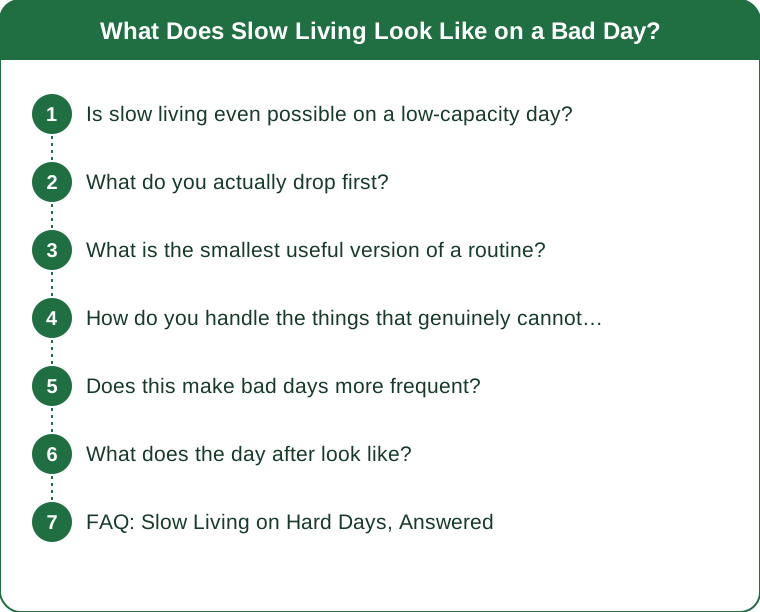
Is slow living even possible on a low-capacity day?
Yes, and it is arguably the only day it does anything.
On a good day, slowness is a preference. You have the capacity to do things fast and you are choosing not to. On a bad day you do not have that capacity, which means slowness stops being a choice and becomes the only available speed — and the practice becomes whether you can accept that instead of fighting it.
The fighting is the expensive part. Most of the exhaustion on a bad day is not the day itself. It is the running commentary about how you should be handling the day better, the mental recalculation of everything you are not getting done, and the guilt tax applied to every hour of rest.
So the honest reframe: on a bad day, slow living is not a set of practices you add. It is the removal of the pressure to perform normal capacity. That is the entire thing. Everything below is downstream of it.
It is worth naming what kind of day we are talking about, too. Low physical energy, a rough mental health day, illness, grief, the flat day after a hard week, or the specific fog of a bad night’s sleep. The mechanics are similar even when the causes are not, and none of them are character failures.
What do you actually drop first?
The aesthetic layer, immediately and without negotiation.
A lot of what gets called slow living is really slow living’s costume: the ceramic pour-over, the handwritten journal, the tidy surfaces, the unhurried breakfast that photographs well. All of that is optional and all of it is expensive when your reserves are low.
Drop in this order:
- Anything performed. The pour-over becomes instant coffee. Nobody is grading it, and the caffeine is chemically identical.
- Anything with setup cost. If the practice requires clearing a surface first, it is not happening today. Choose the version that starts where you already are.
- Anything with a duration. “Twenty minutes of journaling” becomes one sentence, or nothing. Time-based commitments are the first thing to break and the first thing to generate guilt.
- Anything social that is optional. The coffee you said yes to three weeks ago from a different amount of energy is allowed to be rescheduled.
What survives is small and unglamorous: water, some food that requires no decisions, opening one window, and putting on clothes that are not the ones you slept in. That is a legitimate slow living day. It looks like nothing and it holds the shape.
What is the smallest useful version of a routine?
One anchor, chosen in advance, that takes under five minutes.
The problem with routines on bad days is that they are usually chains — six steps where step one triggers step two. Break any link and the whole thing collapses, and then the collapse itself becomes evidence that you are failing.
Pick one anchor per part of the day and let everything else be optional:
- Morning anchor: open the curtains and stand there for sixty seconds. Light exposure early does real work on your circadian rhythm and mood, and it requires no equipment, no decisions, and no capacity.
- Midday anchor: eat something you did not have to plan. This is what the emergency shelf in your kitchen is for — three things that require no cooking and no thinking.
- Evening anchor: one surface cleared, or one thing put away. Not the room. One thing.
The rule that makes this work: the anchor cannot have a quality standard. Standing at the window while feeling terrible counts. Eating crackers counts. The anchor is a place to touch, not a performance to complete.
And choose your anchors on a good day, while you have the executive function to decide. A bad day is a terrible time to design a system, which is why so many bad days end with the discovery that there was no system.

How do you handle the things that genuinely cannot wait?
You triage honestly, and you find the smaller shape of each one.
On a bad day, most people do one of two things: pretend everything is urgent and burn out completely by 2pm, or declare everything impossible and then spend the day anxious about the actual deadline that actually exists.
The honest triage is three buckets:
Truly time-locked. The medication, the pickup, the thing with a legal or medical consequence, the person expecting you at a specific time. Usually one to three items, almost never the ten your brain is holding.
Consequential but movable. The email that should go today but could go tomorrow morning with a one-line apology. Move it, and send the one line now so it stops taking up space.
Feels urgent, is not. Almost everything else. The tidying, the inbox, the thing you told yourself you would start. These are not failures deferred, they are items that were always going to move.
For the first bucket, ask what the smallest acceptable version is. Dinner can be cereal. The pickup can happen without the errand attached to it. The work call can happen with camera off and a two-line agenda instead of a prepared one.
And the underrated move: tell one person. “Rough day, I am doing the minimum” removes an enormous amount of the invisible labor of appearing normal, and most people respond better than you expect.
Does this make bad days more frequent?
This is the fear underneath the question, and it is worth answering directly.
The worry is that permission becomes a habit — that if you accept one low day you will accept fifty, and slow living becomes a nicer word for giving up. It is a reasonable thing to be suspicious of.
In practice the opposite is more common. The days that turn into weeks are usually the ones where somebody spent all their remaining capacity fighting the day instead of resting through it, and then had nothing left the following morning. A low day that is accepted early tends to end. A low day that is fought tends to recruit tomorrow.
There is a real distinction to hold, though, and it is not about frequency of individual days:
- A bad day handled well ends with you slightly better resourced than it started, or at least not worse.
- A pattern that needs attention is when the days stop being distinguishable — when there is no day you feel like yourself, when the low capacity has lasted weeks rather than days, or when you have stopped wanting things you used to want.
That second pattern is not a slow living problem and no amount of curtain-opening resolves it. That is the point at which the useful move is talking to a doctor or a therapist, and treating that as maintenance rather than as an emergency. This is general information, not medical advice, and if you are struggling persistently, a professional is genuinely the right next step.
The practice, honestly held, actually makes that easier to notice. When you are not spending every low day in a fog of self-criticism, you can see the shape of the pattern more clearly.
What does the day after look like?
Gentler than you want it to, and that is the part people skip.
The strong temptation on the morning after a low day is to compensate — to do the missed things plus the current things, on the theory that yesterday created a debt. This is how one bad day becomes two. You spend a recovering day’s worth of energy on a catch-up day’s workload and you are back where you started by evening.
A better shape for the day after:
- Do one deferred thing, not all of them. Pick the one with the actual consequence. The rest can distribute across the week.
- Keep the anchors. They matter more on a recovery day than a good one, because a recovering day is fragile and unstructured.
- Do not audit yesterday. The review of what you should have done is not information, it is just cost. If there is a genuine lesson, it will still be there on Saturday.
- Notice what actually helped. This is the only useful reflection. Was it the window? The food? Telling someone? Write the one thing down somewhere you will see it, because your bad-day self will not be able to generate it from scratch.
Over time this builds something more durable than any morning routine: a short, tested list of what works for you specifically when you have nothing, which is the only version of slow living that survives contact with an actual life.
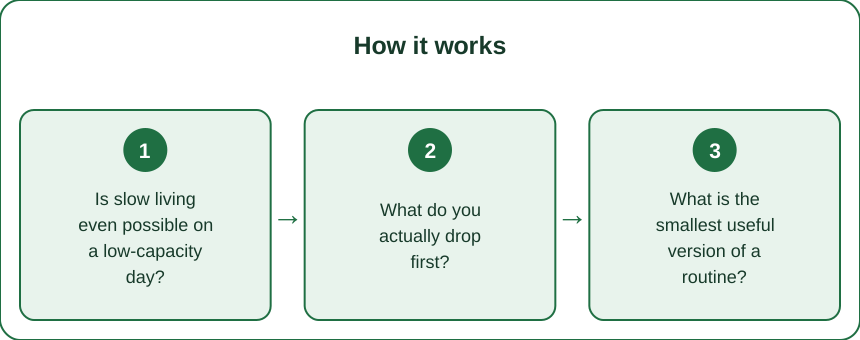
FAQ: Slow Living on Hard Days, Answered
Isn’t this just resting? Why call it slow living?
Partly, yes, and the label matters less than the practice. The distinction worth keeping is that resting is the activity and slow living is the permission structure around it — the part that decides a day of rest is a legitimate day rather than a failed one. Plenty of people rest and feel worse afterward because of the commentary attached.
What if I have kids and cannot scale down?
You can scale down further than it feels like, just not to zero. The floor is different — someone is getting fed and kept safe — but the aesthetic layer still goes first, the standards still move, and screen time on a low day is a tool rather than a moral event. And the smallest version of most household tasks is much smaller than the default version.
How do I tell a bad day from being lazy?
Mostly you cannot in the moment, and the question itself is usually a symptom rather than a useful diagnostic. Laziness is a judgment; low capacity is a state. The practical answer is that treating a low day as a low day costs you one day if you are wrong, while treating it as laziness and pushing through costs you several if you are right.
TL;DR:
- On a low day, slow living is subtraction and permission, not added rituals
- Drop the aesthetic layer first — the costume is the expensive part
- Keep one under-five-minute anchor per part of the day, chosen in advance on a good day
- Triage honestly into time-locked, movable, and not-actually-urgent, and find the smallest version of each
- Do not compensate the next morning; that is how one day becomes two
A practice that only works on good days is decoration. The measure of this one is whether it still holds on a Tuesday when you have nothing, and the answer is that it holds by asking for almost nothing.
Keep Reading
This article is for general informational and styling purposes only. Fit, sizing, and product availability may vary.