Why Your Slow Morning Routine Falls Apart by Wednesday (and How to Fix It)
Quick Answer: Slow mornings fail by Wednesday because they’re usually built on Monday’s energy and Monday’s schedule, not a realistic weekly rhythm — the fix is a 3-tier version (full, medium, minimum) instead of one fixed routine.
Monday: 20 minutes of quiet coffee, journaling, maybe stretching. Wednesday: alarm snoozed twice, coffee in the car. It’s not a willpower problem. It’s a design problem.

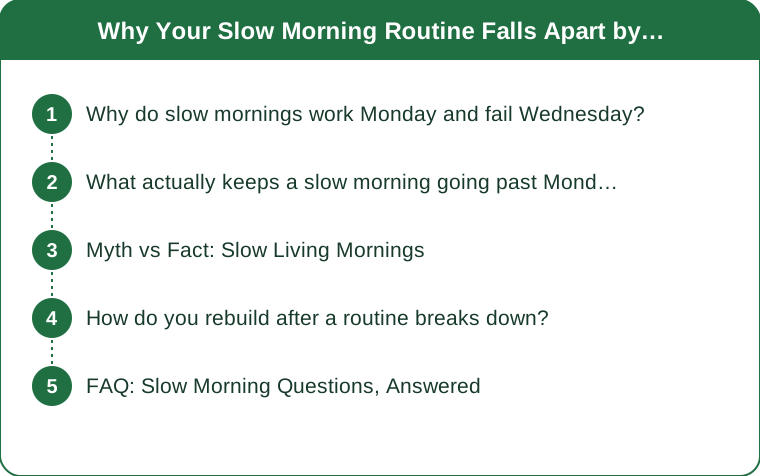
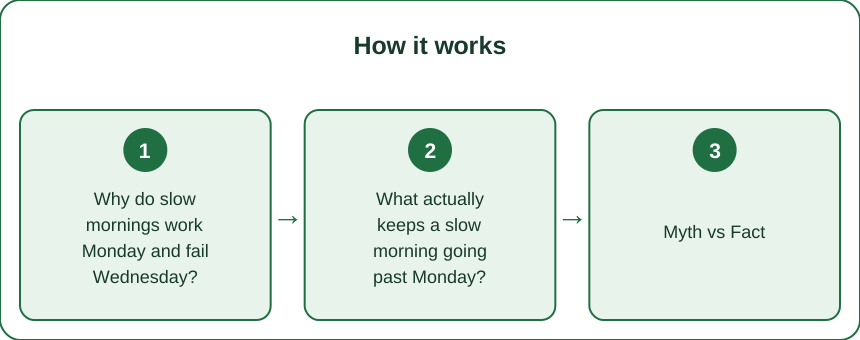
Why do slow mornings work Monday and fail Wednesday?
Most slow-morning routines are designed during a rested, motivated moment — usually Sunday night or Monday — and that energy simply isn’t available by midweek, when sleep debt and accumulated decisions have piled up.
A 20-minute routine costs more willpower on day three than day one. That’s not a flaw in you; it’s math the routine never accounted for.
What actually keeps a slow morning going past Monday?
Building 3 versions of the same routine — full, medium, and minimum — instead of one fixed version is what survives a real week.
Full (20 min): tea, journal, stretch. Medium (8 min): tea, 3 deep breaths, one intention. Minimum (90 seconds): drink water sitting down before touching your phone. Doing the minimum version counts as a win — it’s not a failure of the ‘real’ routine.

Myth vs Fact: Slow Living Mornings
Myth: A slow morning has to be at least 20 minutes. Fact: The research on morning routines points to consistency mattering more than duration — a 90-second version done daily beats a 30-minute version done twice a week.
Myth: If you check your phone first, the morning is ruined. Fact: One habit rarely derails a whole morning. What derails it is the spiral of guilt afterward, not the phone itself.
Myth: Slow mornings require waking up earlier. Fact: You can build one into your existing wake time by removing a step, not adding a wake-up hour you won’t sustain.
How do you rebuild after a routine breaks down?
Restart with the minimum version, not the full one. Trying to jump back to the 20-minute routine after missing 4 days usually triggers another drop-off within a day or two.
A simpler pattern that holds: pick one anchor habit (often just sitting down for the first sip of coffee, no phone) and let everything else be optional. One anchor habit, done consistently, does more for the ‘slow’ feeling than a five-step routine done occasionally.
FAQ: Slow Morning Questions, Answered
How long should a slow morning routine actually be?
There’s no fixed minimum — even 90 seconds of an unhurried first sip of water or coffee, done daily, builds the effect more reliably than a long routine done inconsistently.
What if I have kids or an early commute?
Use the minimum-version idea: one small unhurried moment (even in the bathroom before anyone wakes) still counts and is more sustainable than trying to fit in a full routine.
Is it bad to check my phone first thing?
Not inherently — the bigger issue is the guilt spiral afterward. If it derails your whole morning, delay it by even 10 minutes as a starting adjustment.
TL;DR:
- Slow mornings fail midweek because they’re designed on Monday’s energy, not a realistic weekly rhythm
- Build 3 tiers (full/medium/minimum) instead of one fixed routine
- One anchor habit beats a five-step routine you can’t sustain
- Restart with the minimum version after a break, not the full one
Pick your 90-second minimum version today — that’s the one that actually survives Wednesday.
Keep Reading
This article is for general informational and styling purposes only. Fit, sizing, and product availability may vary.